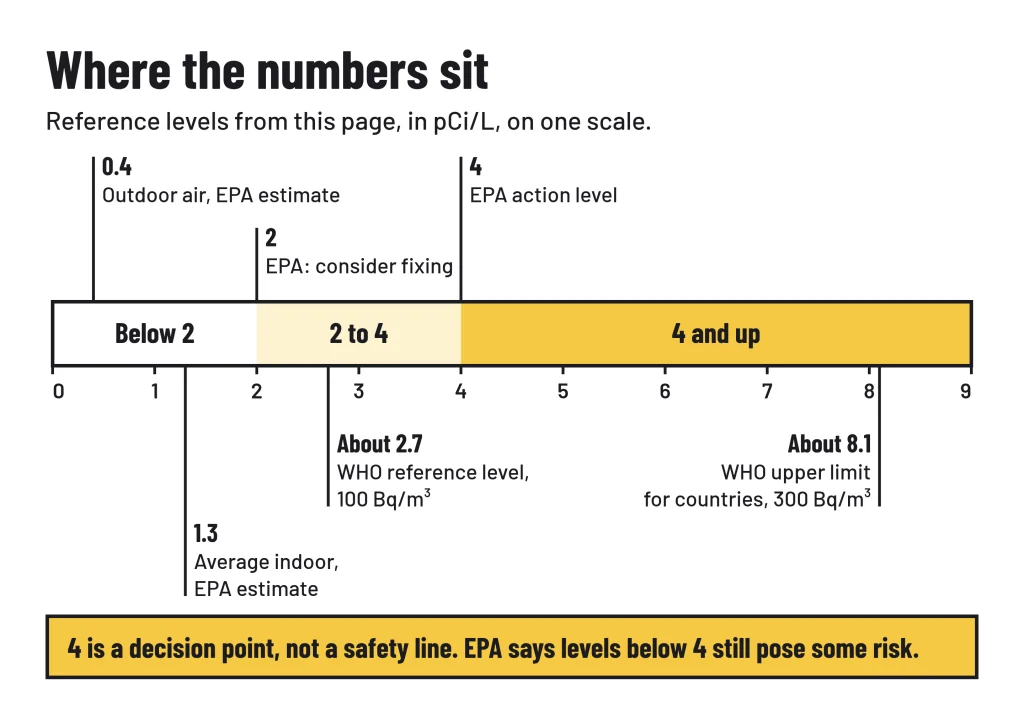
EPA’s action level is 4 pCi/L (picocuries per liter of air). A first short-term test at 4 or higher means test again, not fix yet. A long-term test at 4 or higher means fix the home, and two short-term tests averaging 4 or higher mean fix or consider fixing, depending on the row below. Between 2 and 4, EPA says “consider fixing”. Below 2, EPA says you may want to test again sometime in the future. Enter your number and test type in the reader on this page, and it gives you a row in the table below.
That 4 is a decision point, not a safety line. EPA says “no level of radon is safe” and that levels below 4 pCi/L still pose some risk, so the reader never calls a number safe. See our radon levels guides for more on why levels move.
EPA’s next step, row by row
The row depends on the kind of test as well as the number. A short-term test stays in the home for 2 to 90 days, and a long-term test for more than 90 days. EPA says a long-term test is more likely to tell you your year-round average. Our guide to short-term and long-term tests goes through the trade-offs.
| Row | Your test and level | EPA’s next step, in its words | Source |
|---|---|---|---|
| 1 | Any test below 2 pCi/L, except a single short test in a sale | “Even if your test result is below 4 pCi/L, you may want to test again sometime in the future.” | Citizen’s Guide |
| 2 | 2 to just under 4 pCi/L, except a single short test in a sale | “Consider fixing if your level is between 2 and 4 pCi/L” | EPA zone page |
| 3 | First short-term test, 4 to 8 pCi/L | “Follow up with either a long-term test or a second short-term test” | Citizen’s Guide |
| 4 | First short-term test, above 8 pCi/L | “you should take a second short-term test immediately” | Citizen’s Guide |
| 5 | Long-term test, 4 pCi/L or more | “Fix your home if your long-term test result is 4 pCi/L or more.” | Citizen’s Guide |
| 6 | Two short-term tests, no sale, average 4 pCi/L or more | “Consider fixing your home if the average of your first and second test is 4 pCi/L or higher” | Citizen’s Guide |
| 7 | Home sale: two short-term tests or one continuous monitor, average 4 pCi/L or more | “Fix the home if the average of the two tests is 4 pCi/L or more.” For a monitor: “Fix the home if the average radon level is 4 pCi/L or more.” | Buyer’s and Seller’s Guide |
| 8 | Home sale: one short-term test so far, at any level | Not one of EPA’s three sale options yet. Its sequential option: “Immediately upon completing the first test, do a second test using an identical device in the same location as the first test.” If there’s time, a long-term test works too. | Buyer’s and Seller’s Guide |
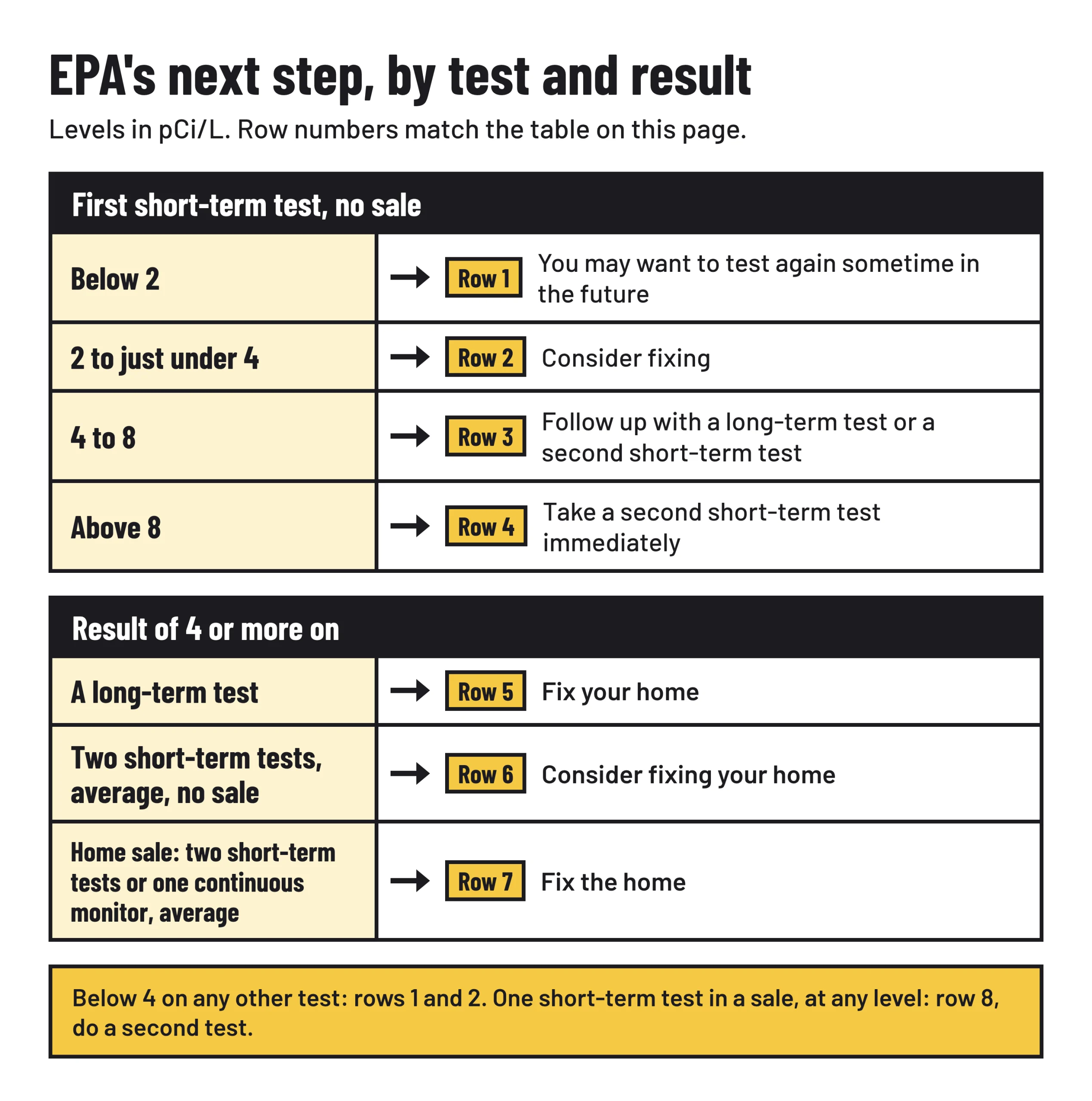
The higher a first short-term result, the more EPA leans toward a quick follow-up. Its guide says the higher the first number, the more certain you can be that you should choose a short-term follow-up over a long-term one. That matters near the top of row 3.
How the reader works
The reader does four small jobs. If you enter Bq/m³ (becquerels per cubic meter), it divides by 37 to get pCi/L. That comes from EPA’s unit figures: 1 curie is 3.7 × 10¹⁰ becquerels, which makes 1 pCi/L equal to 37 Bq/m³. If you ran two short-term tests, it averages them. It divides the level by 4 to show how it compares with the action level. Then it picks the row. If you want only the unit change, use the pCi/L to Bq/m³ converter.
Worked example, using the default values: a first short-term test at 5.2 pCi/L, no sale. 5.2 × 37 = 192.4 Bq/m³, shown as 192. 5.2 ÷ 4 = 1.3 times the action level. It’s one short-term test between 4 and 8, so the reader shows row 3: take a follow-up test.
With two tests: 3.8 and 4.4 average (3.8 + 4.4) ÷ 2 = 4.1 pCi/L. With no sale that’s row 6. In a sale it’s row 7. The reader also shows the higher test divided by the lower, here 1.16, which the section on tests that disagree uses.
Exactly 8 stays in row 3, because EPA’s wording is “more than twice” 4 pCi/L. A digital consumer monitor goes under one short-term test unless the reading covers more than 90 days. For a sale, the continuous monitor option in the reader assumes a test set up for the sale, and the section on monitors below explains why a home unit is a weaker fit.
Read your report first

The number on a report is an average over the test, not a peak. EPA notes that active devices usually give hourly readings and an average for the test period. Minnesota’s report form (2023) shows the fields a licensed tester fills in: device model, test location, serial number, start and end date and time, and average level. Before you enter your number, check these points.
- Unit. pCi/L is the usual US unit. EPA prints 4 pCi/L as 150 Bq/m³ and 2 pCi/L as 75, which are rounded. The exact conversion for 4 is 148, and the reader uses that, so 148 or 149 counts as 4 or more.
- Working levels. Some reports use WL. EPA says to fix the home at 0.016 WL or higher, and notes that some states require WL results to be converted to pCi/L. Ask the lab for the pCi/L figure before using the reader.
- Test length. EPA says all radon tests should run at least 48 hours. A shorter run falls outside EPA’s steps.
- Where it sat. EPA says to use the lowest lived-in level, in a room that’s used regularly but not the kitchen or bathroom, at least 20 inches above the floor. For a sale, EPA’s level is the lowest one that could be used regularly.
- House conditions. On a short-term test, windows and outside doors stay closed as much as possible. For a test lasting less than four days, close them 12 hours before too, and don’t test during severe storms or high winds.
- Return time. A late kit can spoil the reading. One national kit program says short-term kits must reach its lab within 10 days of ending the test. Your kit’s instructions rule.
- A less-than sign. If the result reads something like “<0.4”, we found no EPA text on it. Ask the lab what its lower limit means.
If the test length, placement, house conditions or return time went wrong, run another test. Our guide to setting up a radon test goes through it in full.
What the levels mean
For scale, EPA estimates the average indoor level at about 1.3 pCi/L and outdoor air at about 0.4 pCi/L. Those are old figures: EPA’s 2025 analysis says no national radon data newer than the 1990s exists. The World Health Organization recommends a national reference level of 100 Bq/m³, about 2.7 pCi/L, or no more than 300 Bq/m³, about 8.1 pCi/L, where 100 can’t be reached. That’s a level for countries to set, not a personal limit, and the 100 figure sits lower than EPA’s 4.
EPA’s risk table in the Citizen’s Guide is the source to use for what a level means for health. The figures cover people exposed at that level over a lifetime, and the guide’s footnote says they’re lifetime risks of lung cancer deaths from EPA’s 2003 risk assessment.
| Radon level, pCi/L | If 1,000 people who smoked were exposed over a lifetime | If 1,000 people who never smoked were exposed over a lifetime | EPA’s table says |
|---|---|---|---|
| 20 | About 260 could get lung cancer | About 36 could get lung cancer | Fix your home |
| 10 | About 150 | About 18 | Fix your home |
| 8 | About 120 | About 15 | Fix your home |
| 4 | About 62 | About 7 | Fix your home |
| 2 | About 32 | About 4 | Consider fixing between 2 and 4 pCi/L |
| 1.3 (average indoor) | About 20 | About 2 | Reducing radon levels below 2 pCi/L is difficult |
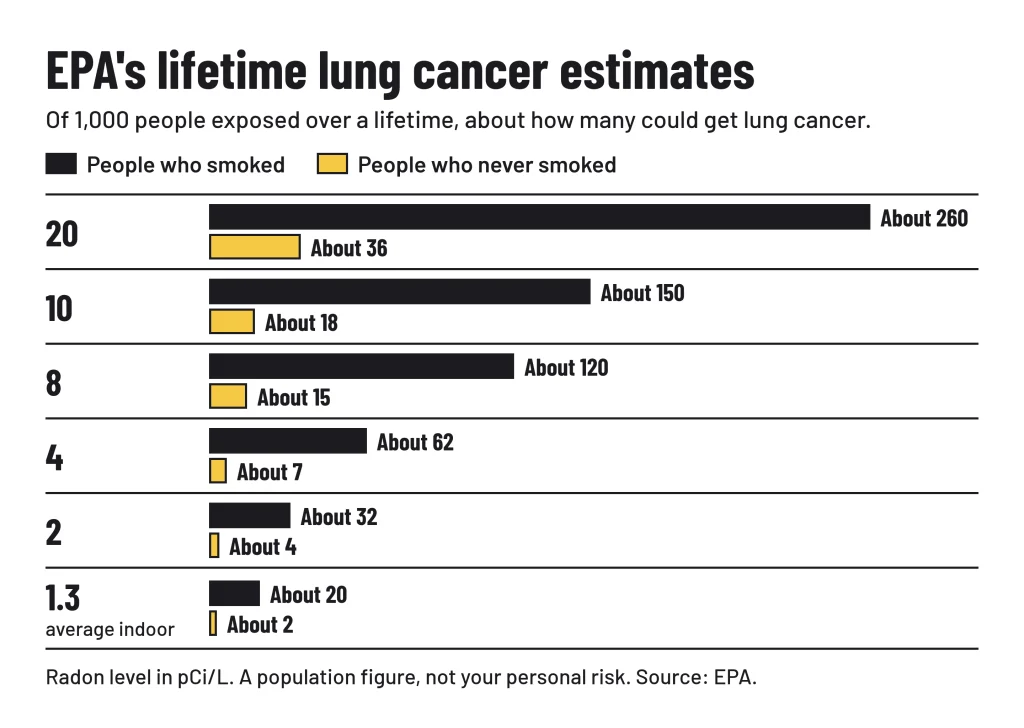
This is a table for a population over a lifetime, not your personal risk, and it isn’t a forecast from a single test. EPA also says: “Not everyone exposed to elevated levels of radon will develop lung cancer.” CDC says “There is no known safe level of radon” and that reducing radon will always help reduce your risk, even when the level is below 4 pCi/L. If you’re worried about your health, talk to a doctor, and tell them if you smoke. Our page on how much radon exposure is dangerous covers what EPA and NCI do and don’t state.
Close to 4, or tests that disagree
Results near 4 are the hardest to read, and a small gap between 3.9 and 4.1 means less than it looks. EPA’s example: if two short-term tests average 4.1 pCi/L, there’s about a 50% chance the year-round average is somewhat below 4. Its buyer’s guide says somewhat below, or above. EPA’s answer isn’t to dismiss a 3.9. It says levels below 4 still pose some risk, and that between 2 and 4 you should consider fixing.
If you have time, a long-term test is the better tie-breaker, because it’s more likely to reflect your year-round average. In a sale that may not be possible, and EPA accepts short-term options when you need results quickly.
Two tests can also land on either side of 4. The professional testing standard, ANSI/AARST MAH-2023, deals with this in section 7.2. If the higher result is under twice the lower one, average them. If it’s more than twice, repeat a side-by-side test, or for tests run at different times, test further unless you’ve decided to fix anyway. Until more testing says otherwise, the higher result counts. In the reader, that’s the “higher test divided by lower test” line: above 2 with tests either side of 4, retest before relying on the average.
Low numbers have their own limit. The same standard says results below about 2 pCi/L are normally lower than devices can accurately measure, so 0.9 and 1.4 don’t need explaining. They’re the same answer: row 1.
If your number came from a home monitor
A digital home monitor is a useful way to watch a trend, but it’s a weaker basis for a decision. Minnesota says it currently does not recommend them for real estate transactions or mitigation decisions (updated 31 August 2026), and Wisconsin says consumer monitors are not for those decisions. A 2021 note from National Radon Program Services says these units haven’t been through the proficiency program’s evaluation, and it recommends confirming any elevated result with a listed device, such as a charcoal kit from an accredited lab.
Studies show why. In a UK Health Security Agency study (2024) at about 4.5 pCi/L, one of seven monitor types was within 10% and the others were off by 20% to 50%. A 2026 Canadian study in one home at about 2.7 pCi/L found the best models within 3% to 5% after 13 weeks and some others from 47% under to 220% over. Those are the abstracts’ figures, and we name no models. So a monitor at 3.4 or 4.6 could fall in a different row with a lab test. Our guide to radon monitors has more.
Where EPA and the states differ
EPA isn’t fully consistent, and some states write their own steps. Your state’s page can read differently from the table above, and here’s where.
- “Fix” or “consider fixing”. On two short-term tests averaging 4 or higher, the Citizen’s Guide says “consider fixing”. The Buyer’s and Seller’s Guide says “fix” for the same numbers in a sale. The summary page at the front of the Citizen’s Guide says “Fix your home if your radon level is 4 picocuries per liter (pCi/L) or higher.” That’s why rows 6 and 7 are separate.
- Below 4. Wisconsin tells residents below 4 pCi/L that the home has low levels and they “do not need mitigation”, and to retest every 2 to 5 years (page revised 21 October 2026). EPA says to consider fixing from 2. CDC says reducing radon helps even below 4.
- The first follow-up. Minnesota (updated 31 August 2026) sends a first result of 2 to 7.9 pCi/L to a long-term follow-up and 8 or greater to a short-term one. EPA asks for a follow-up only from 4, and lets you choose either kind up to 8.
- Retesting below 4. EPA says only “sometime in the future”. Wisconsin and Minnesota both say every 2 to 5 years.
Local rules can add to these, and we haven’t surveyed every state. EPA’s page of state contacts lists your state’s radon office, which is the one to ask.
What to do next
Rows 3, 4 and 8: test again. In row 4, EPA says to do it immediately. Use the same room and setup. As one dated example, the K-State-run National Radon Program Services listed a short-term kit at $20 and a long-term kit at $30, costs included, on 4 November 2026, with $10 more on short-term kits in New Jersey. Check it’s still available. EPA says free kits are sometimes available from local or county health departments or state programs. As of 4 November 2026, federal radon funding runs on a stopgap through 11 December 2026. The President’s budget proposed ending it, and Congress hasn’t finished the FY27 bill.
Rows 5 and 7: fix. Row 6: consider fixing. On row 6, EPA adds: “The higher your short-term results, the more certain you can be that you should fix your home.” On who does the work, EPA’s words are: “You should use a contractor who is trained to fix radon problems.” Your state radon office can tell you about licenses and lists. EPA names two privately run national proficiency programs, NRPP and NRSB. EPA doesn’t certify anyone itself. Our mitigation cost calculator shows published prices and a worked build-up. Sealing cracks alone isn’t a fix: EPA says sealing by itself hasn’t been shown to lower radon levels significantly or consistently.
Row 2: weigh it. EPA says most homes today can be reduced to 2 pCi/L or below, though its table adds that going below 2 is difficult. A long-term test will tell you more than a single short one before you spend money.
Row 1: keep the report. Test again if you start using a lower level of the home, and after major renovation. EPA says to “always test again after work is completed”.
In a sale, keep the test dates and conditions with the report. EPA notes a buyer may ask for a new test, for example if the last one wasn’t within two years or the home was renovated after it. Who pays and who tests belong in the contract, and our page on radon testing and home inspections covers that.
After any fix, test again. EPA’s Consumer’s Guide says to do it within 30 days of installation, and no sooner than 24 hours after the system starts, and to retest at least every two years. If the system’s monitor shows it isn’t working properly, EPA says to call a contractor to have it checked. Our page on reading a radon manometer shows what to look at.
Ask the tester or lab:
- What device was used, and is it on the NRPP or NRSB list or your state’s?
- Were closed-house conditions kept, and how do you know?
- Which room and floor was tested, and is that the lowest level we use?
- Is this one average, or can I see the hourly readings?
- If the result is near 4, what follow-up test do you suggest, and why?
Radon Handbook sells no tests or systems and refers no one. This page is general information, not medical, engineering or legal advice.
Sources checked on 4 November 2026.
Formulas and sources
- First result in pCi/L: EPA: Radiation Terms and Units, updated 29 Sep 2026
- Second result in pCi/L: EPA: Radiation Terms and Units, updated 29 Sep 2026
- Level used for the next step: EPA: Home Buyer's and Seller's Guide to Radon, 402/K-24/001, March 2024
- Level in Bq/m³: EPA: Radiation Terms and Units, updated 29 Sep 2026
- Level as a multiple of the action level: EPA: A Citizen's Guide to Radon, 402/K-12/002, 2025 cover
- Higher test divided by lower test: ANSI/AARST MAH-2023, section 7.2, read in the free online view
- Row in the table of EPA's next steps: EPA: A Citizen's Guide to Radon, 402/K-12/002, 2025 cover
- Bq/m³ in 1 pCi/L (37, as of 2026-09-29): EPA: Radiation Terms and Units, updated 29 Sep 2026
- EPA action level, pCi/L (4, as of 2025-06-18): EPA: A Citizen's Guide to Radon, 402/K-12/002, 2025 cover
- EPA consider-fixing level, pCi/L (2, as of 2026-08-17): EPA: Map of Radon Zones, updated 17 Aug 2026
Sources
- EPA: A Citizen's Guide to Radon, 402/K-12/002, 2025 cover
- EPA: Home Buyer's and Seller's Guide to Radon, 402/K-24/001, March 2024
- EPA: Consumer's Guide to Radon Reduction, 402/K-10/005, 2025 cover
- EPA: Map of Radon Zones, updated 17 Aug 2026
- EPA: Analysis of Benefits and Costs of Radon Reduction Strategies, October 2025
- EPA: Working levels and picocuries, updated 16 Sep 2026
- EPA: Radiation Terms and Units, updated 29 Sep 2026
- EPA: Map of Radon Zones and Supplemental Information, state contacts, updated 8 Oct 2026
- EPA: Find a radon test kit or professional, updated 30 Dec 2025
- EPA: How do I get a radon test kit? Updated 6 Aug 2026
- EPA FY27 Congressional Justification, State and Tribal Assistance Grants tab
- CDC: About Radon, 18 Jun 2026
- WHO: Radon fact sheet, 25 Jan 2023
- ANSI/AARST MAH-2023, sections 7.1 and 7.2, free online view
- Wisconsin DHS: Radon test results, revised 21 Oct 2026
- Minnesota Department of Health: Radon Testing, updated 31 Aug 2026
- Minnesota Department of Health: Radon Test Report form, passive kits, 6 Oct 2023
- National Radon Program Services: test kits, read 4 Nov 2026
- National Radon Program Services: Consumer Digital Radon Monitors overview, 2021
- Daraktchieva et al., J. Radiol. Prot. 44(3), 2024, abstract
- Giang et al., J. Radiol. Prot. 46(3), 2026, abstract
- CRS R49292, 21 Oct 2026: FY2027 continuing appropriations