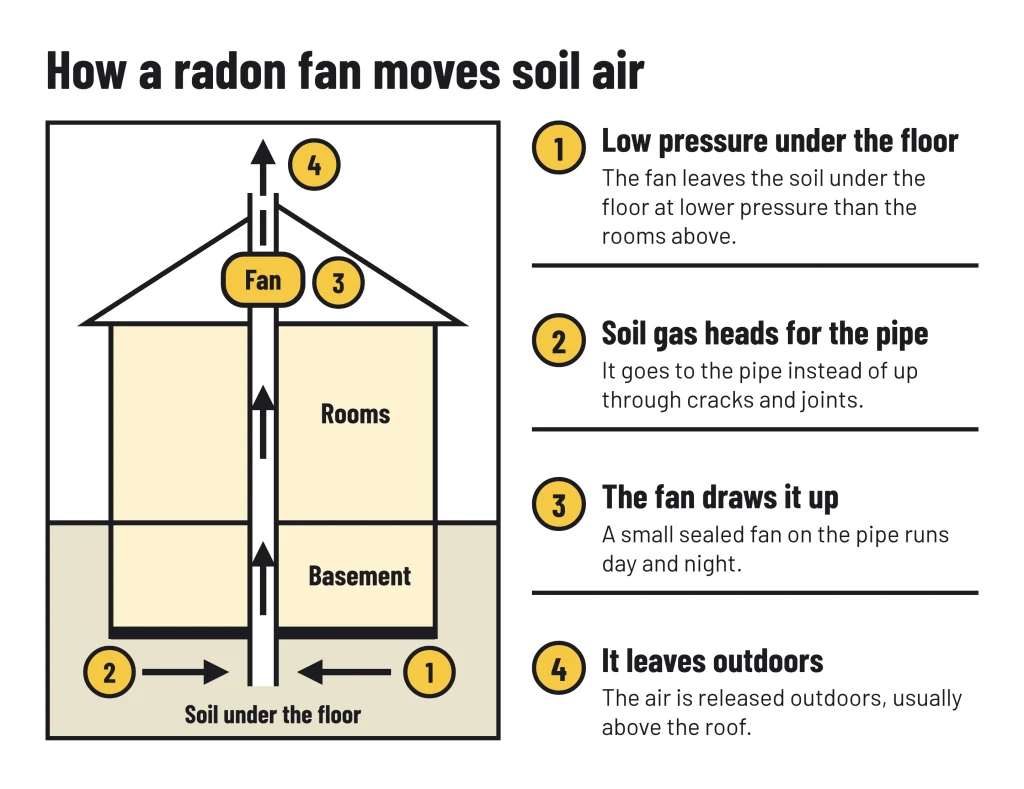
A radon fan is a small sealed fan on your radon pipe that runs day and night. It pulls air from under the house and sends it outdoors, usually above the roof, so less radon gets into your rooms. The whole system depends on it.
Normal means little or no noise indoors, a gauge that sits close to the number marked at installation, and a slightly higher electric bill. There’s no universal “right” reading, so the number to compare against is your own. This page is part of our Living With a System guides.
| What you notice | Usually normal | Get it checked |
|---|---|---|
| Sound indoors | Little or nothing | A new or growing noise, rattling or grinding |
| Sound near the fan or pipe outlet | A low hum, or rushing air at the outlet | Vibration carried through walls or framing |
| U-tube gauge | Liquid levels uneven, close to the marked reading | Levels even, or well away from the marked reading |
| Alarm, if you have one | Silent, no warning light | Sounding or lit |
| Running pattern | On all the time, every day | Off, or cycling on and off |
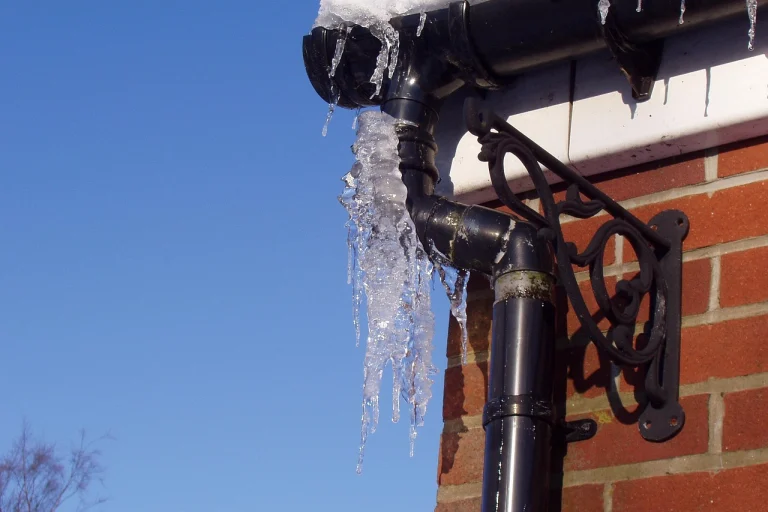
| Water in the pipe | A little condensation draining back down | Gurgling that doesn’t stop, or ice blocking the pipe |
The hum, rattling, grinding and gurgling rows rest on installers’ descriptions, not measurements. The sections below say which is which.
A running fan tells you the fan is running. It doesn’t tell you what your radon level is. Only a test does that, so this page ends with one.
What the fan does
EPA describes the job in its Consumer’s Guide to Radon Reduction (2025 cover): the fan “draws the radon gas from below the home and releases it into the outdoor air while simultaneously creating a negative pressure or vacuum beneath the slab.” That low pressure is the point. The soil under the floor ends up at lower pressure than the rooms above, so soil gas goes to the pipe instead of up through cracks and joints.
The airflow is modest. One maker’s installer manual puts the typical flow for most fans in one series at 25 to 90 cubic feet a minute on 3-inch and 4-inch pipe. Radon fans are built to run nonstop. The same manual lists them as continuous duty and factory sealed, and the ANSI/AARST SGM-SF-2023 standard for mitigating homes requires fans designed for continuous duty.
Why fans come in different sizes
Fans are sold in bands of airflow and suction, because the ground under houses differs. The manual’s rule of thumb: the tighter the material under the slab, the smaller the area one suction point covers. These examples come from one maker’s sheets, shown only to illustrate the spread. It’s not a ranking.
| Example model | Fan duct | Watts | Most suction, in. WC | Typical flow at 1 in. WC, cfm |
|---|---|---|---|---|
| RP140 | 4 in. | 15-21 | 0.8 | None listed |
| RP145 | 4 in. | 41-72 | 2.1 | 82 |
| RP265 | 6 in. | 91-129 | 2.3 | 176 |
| GP501 | 3 in. | 70-140 | 4.2 | 95 |
Sources: RP series sheet, August 2015 and GP series sheet, September 2012, both hosted by a distributor. These are the maker’s figures, and current models may differ. The GP sheet says its 3-inch duct fits 3-inch or 4-inch pipe. “In. WC” means inches of water column, the unit on most gauges.
We don’t offer a square-foot sizing rule, because no source we read ties floor area to fan size. The manual says its fans can cover “up to 2000+ sq. ft.” per slab penetration, depending mainly on the material under the slab. That’s the maker’s upper claim, not a way to pick a fan. EPA says contractors work out the number and position of suction pipes from inspection, diagnostic tests or experience, and one maker’s older fan sheet says the choice of model “should be made by a radon professional”. A bigger fan is not a general fix for a system that isn’t working.
Where it should be
EPA says the fan “must not be located in or below a livable area” and names attics, garages and the outside of the home as common spots. Minnesota gives the reason: keeping it out of living space stops radon leaking back indoors. SGM-SF-2023 is more exact: the fan can’t sit in conditioned or occupiable space or directly beneath it. That rules out a basement, a crawl space, and an enclosed garage with a room above it. A note in the standard prefers a ventilated attic or the outside of the house.
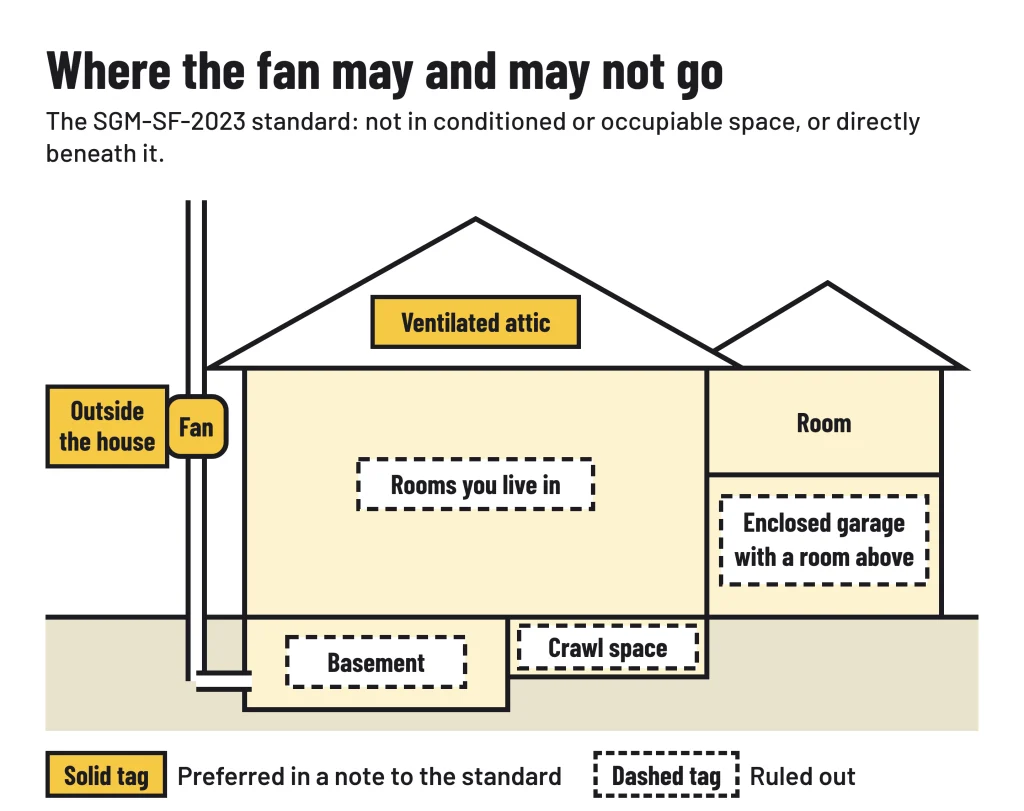
The standard’s reason is that a failed pipe joint or seal could leak radon and soil gas into occupied rooms. That’s a particular risk on the outlet side of the fan, where the pipe is under pressure. If yours is in a basement, don’t move it, but do raise it with a credentialed mitigator. The standard generally doesn’t apply to systems installed before it took effect, but it does reach altered parts, fan location and exhaust placement.
To find your fan, follow the pipe up from the floor. If it runs up inside the house, the fan is probably in the attic. If it runs up an outside wall, the fan is usually a round housing in the pipe. Where the exhaust has to end is covered in our guide to radon pipes and vents.
What a normal fan sounds like
The maker’s manual says a properly installed fan runs with “little or no noticeable noise to the building occupants.” It adds one exception. The “rushing” sound of air leaving the pipe can bother some people, and it suggests an exhaust muffler for that.
Installers’ own guides, which we read but don’t link because we refer no one, describe a low hum near the fan and silence in most rooms. Those are installers’ descriptions, not measurements. We found no decibel figure in the manual or in EPA’s guide. Treat decibel claims on product listings as sellers’ claims.
Noise indoors usually points to the installation, not to radon. Missouri’s health department lists “the noise of the fan from an improperly installed system” as a drawback of having one. The manual tells installers to keep the fan from touching any building surface and to use flexible couplings, both to stop vibration. Installers say grinding or a rising whine often means worn bearings. If you hear anything like that, our noisy or stopped fan checklist goes through it sound by sound.
What the gauge should show
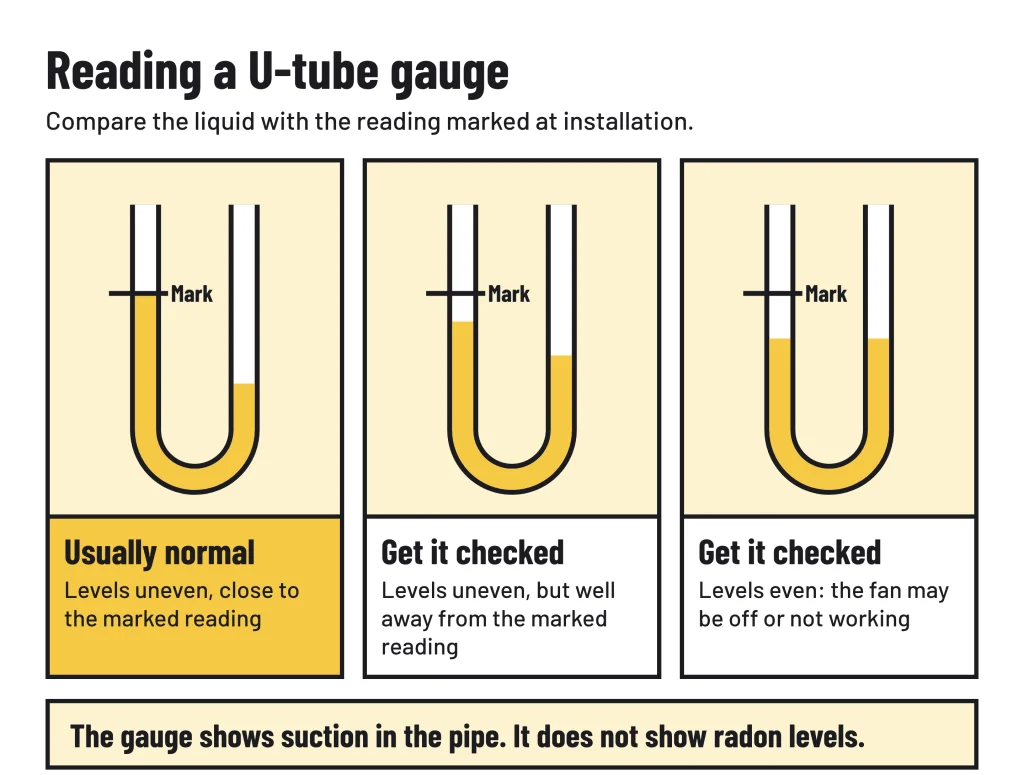
EPA says the warning device is “usually a manometer”. The common kind is a U-tube, a small tube of colored liquid on the pipe. Pennsylvania DEP puts it simply: “The fan is running if the levels of fluid on each side of the glass tube are uneven.” If the two sides are even, the fan may be off or not working. Your reading should be close to the one written on the label at installation. Neither Pennsylvania nor Minnesota gives a percentage for how far it can drift. Minnesota’s owner notice (October 2023) says to act if it’s “significantly different”. Our manometer guide covers how to read it.
The notice adds that the gauge “does not show or measure radon levels, rather it shows there is suction in the pipe.”
The guides and the standard differ on what you need. EPA’s Consumer’s Guide treats a liquid gauge, an alarm, a light or a dial as examples of one required warning device. SGM-SF-2023 asks for more on new or altered systems: a monitor you can see with the start-up values marked (remotely monitored fans are an exception), plus an active alert by sound, light or remote message. So a U-tube alone doesn’t meet the standard on a new or altered system. Older systems aren’t covered on this point, so a U-tube-only system from before the standard isn’t automatically out of line. Minnesota requires both types and tells owners to check them monthly. EPA says only “on a regular basis”, so monthly is a good habit either way.
Before you call anyone, Minnesota suggests two checks: make sure the monitor’s tubing is connected and not kinked, and that power is reaching the fan. Don’t open the fan or touch the wiring.
Water and ice in the pipe
Some water is expected. Condensation forms where the pipe passes through cold space such as an attic, a garage or the outdoors. The maker says the system must be designed so that water drains back to the hole in the slab, which is also why the fan has to be mounted upright. Installers say a brief trickle is normal. National Radon Program Services warns that a badly installed system lets moisture pool in the pipe, and installers link long-lasting gurgling to water sitting in a low spot.
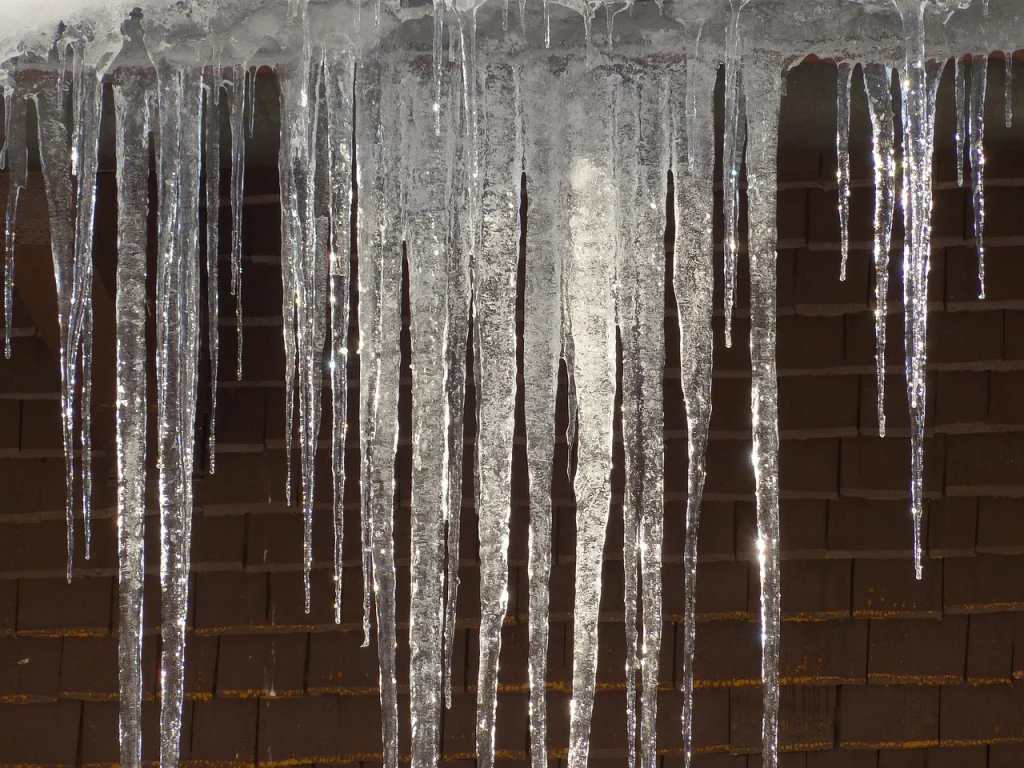
Hard cold can go further. Minnesota’s notice describes a “system freeze-up”, where ice builds up in the pipe and stops radon venting properly. Radon levels indoors will rise while that lasts, the U-tube reads even, and the alarm should go off. If it happens regularly, the notice says the pipe needs insulating in unconditioned areas or other changes, and to call the installer. SGM-SF-2023 also calls for insulation where regular freezing could cause ice buildup.
What it costs to run
EPA says fan systems “will slightly increase your electric bill.” For the electricity alone, take the watts, multiply by 8,760 hours, divide by 1,000 for kilowatt-hours, and multiply by your rate. Our running cost calculator does this for your state. Here it is with the EIA US residential average of 18.16 cents per kWh for August 2026, a preliminary summer-month figure.
| Example model | Watts on the sheet | kWh a year | Electricity a year at 18.16 cents |
|---|---|---|---|
| RP140 | 15-21 | 131-184 | $23.86-$33.41 |
| RP145 | 41-72 | 359-631 | $65.22-$114.54 |
| RP265 | 91-129 | 797-1,130 | $144.76-$205.22 |
| GP501 | 70-140 | 613-1,226 | $111.36-$222.71 |
Your rate changes this a lot. A 72-watt fan comes to $80.23 a year at Nevada’s 12.72 cents and $297.57 at Hawaii’s 47.18 cents, both EIA’s August figures. These are estimates that assume a fan runs at that wattage all year.
The fan also pulls some heated or cooled air out of the house. EPA says most systems cause “some loss” of it, and Minnesota’s notice says its own fan costs leave that out. These published estimates vary because they count different things:
- EPA’s 2025 cost analysis: $206 a year in 2023 dollars as an operating cost, with fan replacement listed separately. It’s a modelling input built from older studies, not a price survey.
- Wisconsin DHS (revised October 2026): “can cost $200 per year in northern climates”, including heating the replacement air.
- Illinois IEMA-OHS (undated): “around $100 per year” for the energy to run the fan.
- Pennsylvania DEP (January 2014): $30 to over $100 a year in operating costs, depending on fan size and other things.
How long a fan lasts
The figures don’t agree, and none is a promise:
- EPA’s guide and its June 2026 Q&A: fans “may last for five years or more”, and warranties “tend not to exceed five years”.
- EPA’s 2025 cost analysis: a replacement every 10 years, as a modelling assumption. It also tests 5 years.
- Pennsylvania DEP (2014): fans “will typically last much longer” than a five-year warranty.
- Another maker’s undated leaflet for an older model line: “Average life expectancy of 7-10 years under continuous load conditions”. That’s the maker’s claim.
None of these tells an owner to swap a working fan at a set age. The gauge, the sound and your retest are better guides. EPA says a worn fan may need repair or replacement. Either way, don’t open it: the manual says there are no user-serviceable parts inside. Warranty terms need reading too. For one maker, the 2018 manual gives 12 months from purchase or 18 from manufacture, whichever is sooner, extended to five years with professional installation. It excludes installation, removal and delivery costs.
EPA gives two replacement figures. Its Q&A says “around $200 – $350 including parts and labor”, with no year or method. Its 2025 analysis uses $476 every 10 years in 2023 dollars. EPA doesn’t explain the gap. Our fan replacement guide goes further.
Why it stays on
Remember, the fan should NEVER be turned off; it must run continuously for the system to work correctly.
That’s EPA’s Consumer’s Guide, with no exception for vacations or quiet nights. The maker adds a reason of its own: don’t leave a fan installed on the pipe without power for more than 48 hours, because “Fan failure could result”. It also says speed controls are generally not recommended. If the power has been out or a breaker has tripped, look at the gauge when it’s back.
A fan that cycles on and off may be overheating. The manual, which is written for installers, says a temporary high water table can push water up the pipe and block airflow. It treats that case differently, with the fan off until the water recedes, but EPA’s guide makes no exception. That’s a decision for your installer, so call before you touch the switch.
What to do next
EPA’s advice for owners comes down to two lines from the Consumer’s Guide:
Later on, if your monitor shows that the system is not working properly, call a contractor to have it checked.
It is a good idea to retest your home at least every two years to be sure radon levels remain low.
Here’s how to run that test. Minnesota’s notice also asks for a retest with any sale and after changes such as altered heating or cooling, an altered radon system or major new cracks. If a retest reaches EPA’s action level of 4 pCi/L (picocuries per liter, the US unit for radon in air) or higher, the notice says more work may be needed. A lower result isn’t a safety line either: EPA’s Citizen’s Guide (2025 cover) says levels under 4 “still pose a risk”.
Start with the name and number on your system label. These questions are worth asking:
- What reading was marked at start-up, and is mine still close to it?
- Is the fan in an allowed location under the current standard?
- Does the system have an active alarm as well as the U-tube?
- EPA notes that a contractor may raise backdrafting, and the maker warns the fan can affect combustion air. Were my fuel-burning appliances checked?
- How old is the fan, what does the warranty cover, and does it include labor?
If your installer is gone, EPA’s page on finding a professional names NRPP and NRSB as the two recognized national proficiency programs, alongside state routes. Its provider Q&A calls both privately run. EPA doesn’t certify anyone itself. State rules vary: Illinois, for one, licenses people who do this work, so check with your state radon office. Radon Handbook sells nothing and refers no one.
This page is general information, not medical, engineering or legal advice. Fan wiring is work for a qualified electrician.
Sources checked on 4 November 2026.
Sources
- EPA: A Consumer's Guide to Radon Reduction (2025 cover)
- EPA: A Citizen's Guide to Radon (2025 cover)
- EPA: How do I know if my radon mitigation system is working properly? (updated 23 June 2026)
- EPA: Analysis of benefits and costs of radon reduction strategies (October 2025)
- EPA: Find a radon test kit or measurement and mitigation professional (updated 30 December 2025)
- EPA: How can you find a qualified radon service provider in your area? (updated 23 June 2026)
- ANSI/AARST SGM-SF-2023, soil gas mitigation standard for homes
- Minnesota Department of Health: Radon mitigation system important safety information (2 October 2023)
- Minnesota Department of Health: Radon mitigation systems (updated 3 October 2024)
- Pennsylvania DEP: Radon in the home
- Pennsylvania DEP: Radon fact sheet 2940-FS-DEP4430 (January 2014)
- Missouri DHSS: Advantages and disadvantages of a mitigation system (undated)
- Wisconsin DHS: Radon-resistant construction (revised 22 October 2026)
- Illinois IEMA-OHS: What is radon (undated)
- Illinois IEMA-OHS: Radon
- National Radon Program Services, Kansas State University: Mitigation details 101 (undated)
- EIA Electric Power Monthly, Table 5.6.A (August 2026, released 23 October 2026)
- Maker: RP/RPc series installation and operating instructions, IN020 Rev X (February 2018)
- Maker: RP series spec sheet (August 2015)
- Maker: GP series spec sheet (September 2012)
- Maker: RP series sheet, March 2008, filed with NY DEC
- Maker: HP series leaflet (undated)