Usually yes, as long as a new radon test run with the system on comes back at a level you accept, and the system itself checks out. A radon system is not a defect. It usually means someone tested the house, found a high number and dealt with it, which is more than you know about most houses for sale.
What the system can’t tell you is today’s radon level. Only a test can. “EPA recommends that you know what the indoor radon level is in any home you consider buying,” says its Home Buyer’s and Seller’s Guide (March 2024). This page, part of our guides to buying, selling and renting, covers what to test, what to look at, which papers to ask for, what a system costs to own and when to push back on the deal.
What a system tells you
The usual story is the one in North Carolina’s brochure on homes with systems (July 2020): “Your home was tested for radon and a high level was discovered,” and a system went in to lower it. So assume the level was high at some point, and ask how high.
A house with no system isn’t the cleaner choice by default. It may simply never have been tested. EPA’s Citizen’s Guide (2025 cover) estimates that “nearly 1 out of every 15 homes” in the US has elevated levels, and warns against relying on a test from a house nearby. Between a tested, fixed house and an untested one, the first is the known quantity.
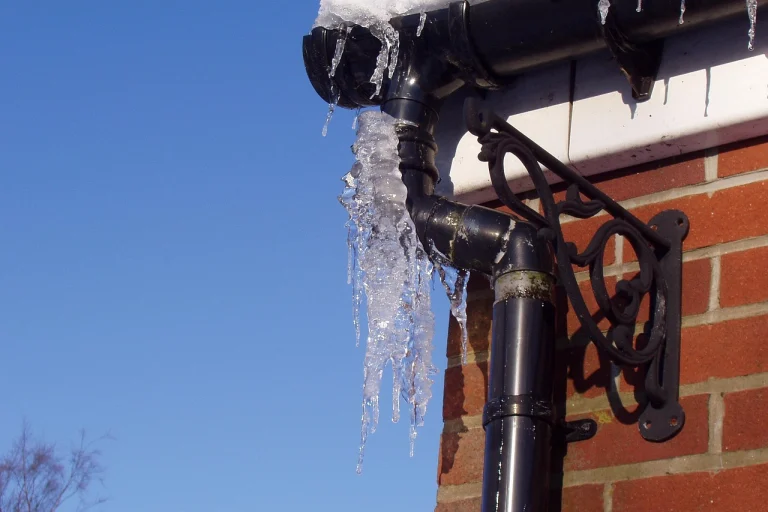
The limit is that a system only works while it runs. EPA’s Consumer’s Guide to Radon Reduction (2025 cover) says the fan “should NEVER be turned off; it must run continuously for the system to work correctly.” Fans wear out, and Minnesota’s system form warns that radon levels rise if ice blocks the pipe in a long cold spell. You’re buying something that has to be kept running, much like a furnace.
Test before you decide
EPA lets a buyer accept the seller’s result or ask for a new test. It says to ask who ran the old test, where in the house, and what has changed since, and it names a test that’s “not recent, e.g., within two years” as a reason for a new one. On a house with a system, a fresh test is also the best check that the system still works. Minnesota’s form (October 2023) says testing to check a system “is to be conducted in conjunction with any sale of a building.” That’s Minnesota’s wording, not a national rule. See our guide to running a radon test for the steps. For a sale, these points matter most:
- System on, fan working. EPA’s checklist: “If the fan is not operating properly, have it (or ask to have it) repaired and then test.” The system must run for the whole test.
- Lowest level you could use. EPA means the lowest level “you are going to use as living space whether it is finished or unfinished.” A seller’s test upstairs says little about the basement you plan to finish.
- At least 48 hours. EPA’s sale options are two short tests at the same time, two in a row, or one continuous monitor. Windows and doors stay closed from 12 hours before a test of 2 to 4 days, except for normal coming and going.
- Someone independent. EPA flags “a potential conflict of interest” when the same firm tests and installs. Choose a tester with no link to the installer or the sale, and consider a non-interference agreement signed by the seller. EPA says disturbing a test “may invalidate the test results and is illegal in some states.”
Reading the result
Results come in pCi/L, picocuries per liter of air, the US unit for radon. All of these assume the system ran throughout the test. Our reader for radon results gives EPA’s next step for any number.
| Result | EPA’s words | What it means for this purchase |
|---|---|---|
| 4 pCi/L or higher | “EPA recommends that you fix the home when the radon level is 4 pCi/L or more.” | Treat it as the system not doing the job until shown otherwise. Minnesota: “additional work may need to be performed.” Get a qualified mitigator’s written diagnosis and price before you remove your contingency. |
| 2 to under 4 pCi/L | “Consider fixing when the radon level is between 2 and 4 pCi/L.” | Ask a mitigator whether the system is working as designed and whether more can be done. EPA says many homes can reach 2 pCi/L or less. |
| Under 2 pCi/L | “A radon level below 4 pCi/L still poses a risk.” | EPA sets no fix point here, but it also says “any radon exposure carries some risk.” Keep the system running and put a retest on the calendar. EPA estimates the average indoor level at about 1.3 pCi/L. |
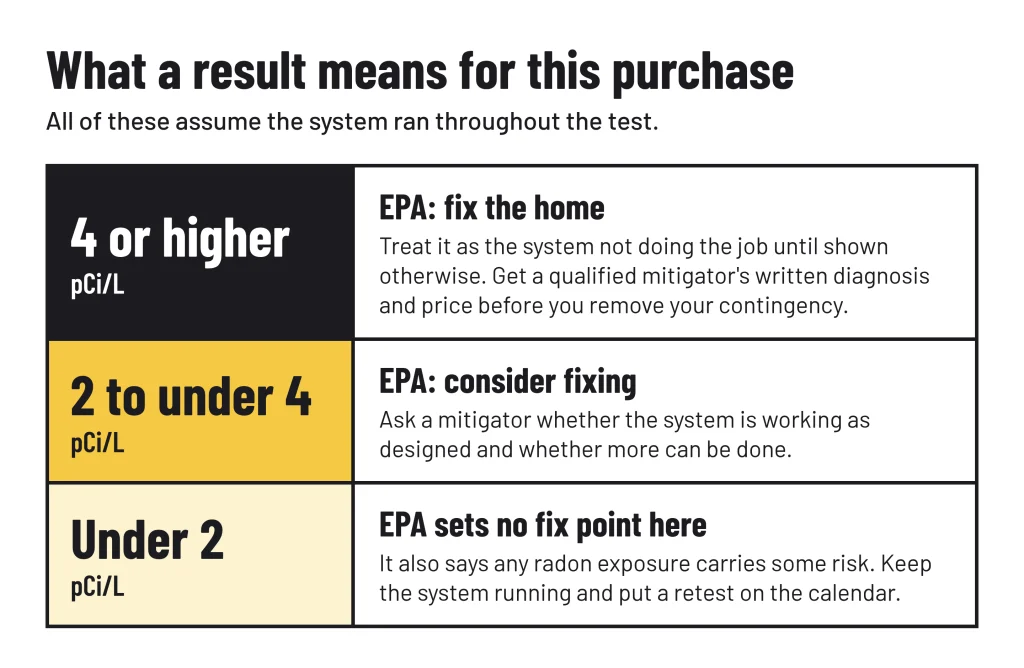
EPA’s guides differ on one point. The Buyer’s Guide says fix at 4 or higher, while the Citizen’s Guide says “consider fixing” when the average of two short tests reaches 4. And close calls are close: EPA says that with two short tests averaging 4.1, there’s about a 50 percent chance the year-round average is “somewhat below, or above,” 4. EPA follows that with its reminder that any exposure carries some risk, so a number just under 4 is no reason to drop the question.
Look the system over
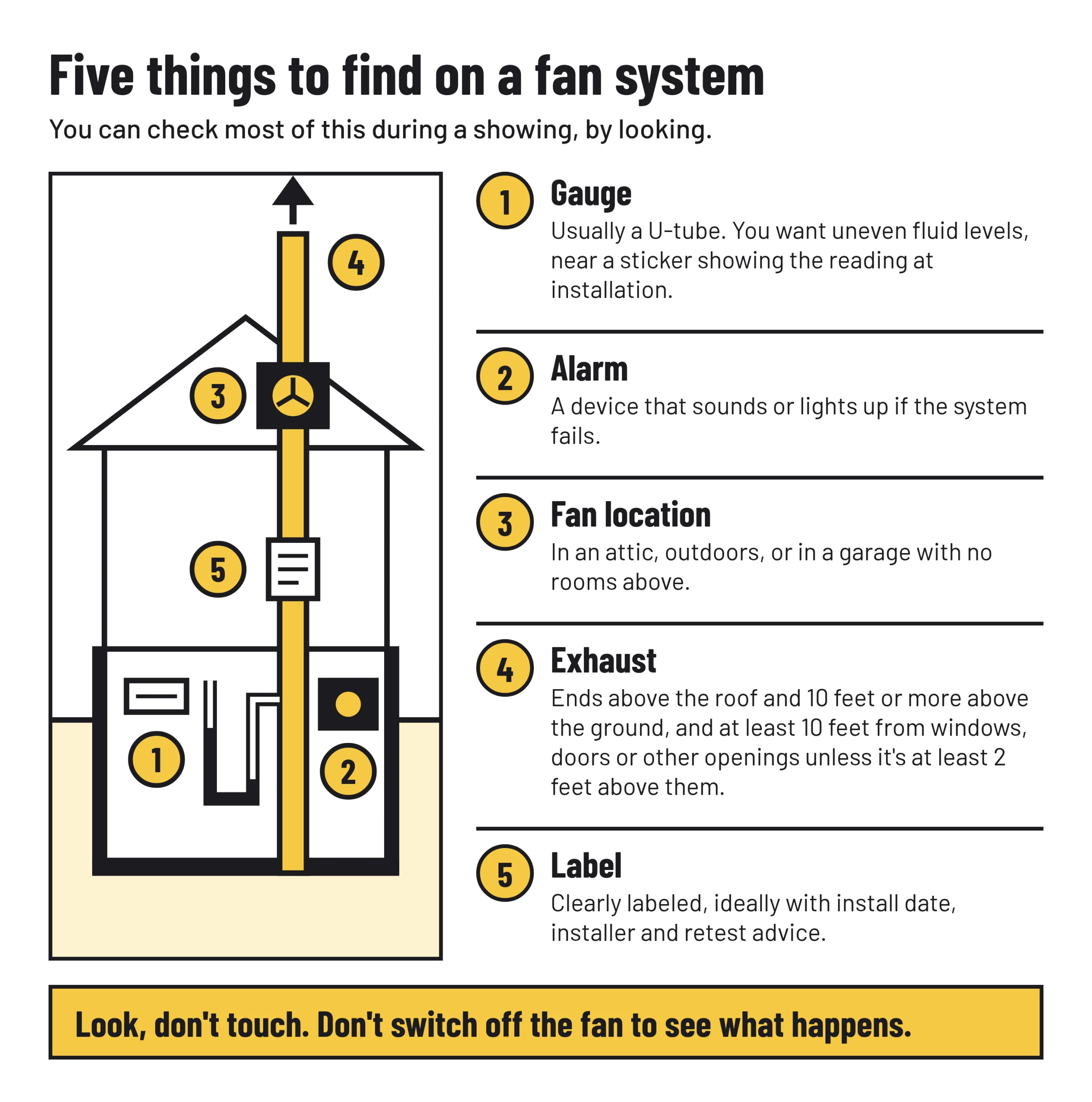
You can check most of this yourself during a showing, by looking and without touching anything. Don’t switch off the fan to see what happens, and leave the wiring to a professional. Five things to find on a fan system:
| Part | What you want to see | Basis |
|---|---|---|
| Gauge | Usually a U-tube manometer (a small tube of colored fluid on the pipe) with uneven fluid levels, near a sticker showing the reading at installation. Even levels mean the fan “may not be working properly or may be off completely.” | Pennsylvania DEP; Minnesota form |
| Alarm | A device that sounds or lights up if the system fails. The current standard asks for a gauge you can see and an active alert too; EPA’s guide accepts one warning device. | ANSI/AARST SGM-SF-2023 8.2; Consumer’s Guide |
| Fan location | In an attic, outdoors, or in a garage with no rooms above. EPA: it “must not be located in or below a livable area.” A fan in a basement is a real finding, because a leak at a joint on the outlet side can put radon into the house. | Consumer’s Guide; SGM-SF-2023 6.5 |
| Exhaust | The pipe ends above the roof and 10 feet or more above the ground, and at least 10 feet from windows, doors or other openings unless it’s at least 2 feet above them. The current standard’s spacing is stricter, and it allows an exhaust below the roof edge only on set conditions, such as at least 20 feet above the ground. | Consumer’s Guide; SGM-SF-2023 6.4 |
| Label | The system is clearly labeled, ideally with install date, installer and retest advice. In Minnesota, also look for the state’s 2023 safety form, which is required to stay attached to the system. | Consumer’s Guide; SGM-SF-2023 8.4; Minnesota form |
The gauge shows suction in the pipe, and it “does not show or measure radon levels,” as Minnesota puts it. There’s no universal correct reading. What matters is how it compares with the sticker, and our guide to reading a radon manometer explains that. Minnesota says levels that are even “or significantly different” from installation may mean a problem.
Don’t treat an older system as failed just because it has a gauge and no alarm. Section 2.2 of the standard says it doesn’t apply to systems installed before it took effect, except for parts altered later and for its exhaust and fan-location rules. It also calls for a sealed lid on a sump pit that connects to the soil (section 7.5).
Want a second opinion? Your state radon office is the place to start. EPA says many states require radon professionals to be licensed, certified or registered, and it says most states can give you a list of radon service providers. EPA doesn’t certify anyone itself: NRPP and NRSB are privately run credential programs. Minnesota says it offers a no-charge inspection for systems installed after June 2020 (page updated 3 October 2024); check that it’s still offered and whether a buyer can ask. Radon Handbook sells nothing and refers no one. A general home inspector may or may not cover radon, as our page on radon in home inspections and loans explains, so ask.
Papers to ask for
EPA tells sellers to inform buyers and supply information on how the system operates and is maintained. Its Buyer’s Guide tells you to ask for “any information they have about the system.” Ask for:
- Radon results from before the system went in, and the test done after it
- Any retests since, with dates
- Install date, installer name and license or credential number
- Warranty on the parts and any guarantee of a radon level, and whether either moves to a new owner
- Operating and maintenance instructions, and any permits
EPA tells homeowners to get a statement of whether warranties are transferable if you sell, and terms differ by installer, so read the document. EPA also says fan warranties “tend not to exceed five years,” so a warranty on an older system may already have run out. If papers are missing, call the installer named on the label: the current standard (section 8.6) has installers keep records for at least 6 years.
Whether a seller must hand any of this over depends on the state, and we found no reliable 50-state list. Minnesota’s statute (read 4 November 2026) requires sellers, with some exemptions, to give information on an installed system, “including system description and documentation.” Colorado’s statute, read in an unofficial copy, requires a seller to say whether one has been installed. Neither makes the seller test or fix. Our state disclosure page has more.
A pipe but no fan
Some newer homes have a passive vent pipe from the builder, with no fan. That’s a radon-resistant feature, not a working fan system, and it doesn’t prove a low level. EPA says every new home should be tested as soon as possible after occupancy, and that at 4 pCi/L or more “a vent fan can easily be added” to make the system active. Ask a qualified mitigator to estimate that upgrade.
What it costs to own
Figures here are dated and come from different kinds of sources, so don’t add them into one number.
| Item | Figure | Source and what it is |
|---|---|---|
| Electricity, 20 W fan | $31.82 a year | Our math: 175.2 kWh at 18.16 cents, EIA US residential average, August 2026, a summer month |
| Electricity, 72 W fan | $114.54 a year | Same method; 630.7 kWh |
| Electricity, 140 W fan | $222.71 a year | Same method; 1,226.4 kWh |
| Fan replacement | “around $200 – $350 including parts and labor” | EPA Q&A, updated 23 June 2026; no year or method given |
| Fan replacement, modeled | $476 every 10 years | EPA cost analysis, October 2025, 2023 dollars; built from older studies |
| Running cost, modeled | $206 a year | Same analysis; electricity and maintenance, not a quote |
| Retest by kit | $20 short-term, $30 long-term | National Radon Program Services at Kansas State, read 4 November 2026; check it’s still available. New Jersey adds a $10 state fee on short-term kits |
| Professional test | $150 to $800 | Bob Vila, a published estimate from 2022; old and wide, so ask testers for their price |
| Alarm, if none is fitted | $59, device only | Battery air-flow alarm, one distributor’s list price, 4 November 2026 |
The three wattages are examples taken from fan makers’ published figures. Running all year at that wattage is our assumption; a fan drawing less costs less. The math leaves out heated or cooled air the system pulls from the house. To use your own numbers, try our fan running cost calculator. EPA says fans may last “five years or more,” its 2025 analysis assumes 10, and our page on replacing a radon fan has the details.
If the result is high and the system can’t be adjusted, compare with the price of new work. Published estimates for a new system include Wisconsin, $1,000 to $2,000, its average contractor cost (revised 21 October 2026); Massachusetts, $1,200 to $2,000 for most systems (updated 7 October 2025); Vermont, $1,500 to $2,500, its estimated installation cost for an active soil depressurization system, the usual fan-and-pipe type (January 2024); and Minnesota, “$1,500 to $3000” in general (figure undated, page updated 3 October 2024). For its 2025 analysis, EPA used $1,826 in 2023 dollars, built from older studies adjusted for inflation. None is a market survey, and repairing an existing system may cost less or more. Our mitigation cost calculator works through a new install.
Resale and loans
We found no study that isolates what a radon system does to a sale price, so treat any percentage you see with care. EPA’s Citizen’s Guide says that where radon problems have been fixed, home sales “have not been blocked or frustrated,” and that the added protection is “sometimes a good selling point.” The nearest data is about testing, not systems: an American Lung Association case study (2021, analysis by a University of Iowa researcher) found no significant effect on sales volume or median price after Montgomery County, Maryland, required radon tests in home sales. That’s one county, from a group that campaigns on radon.
You may read that “FHA or VA requires a radon test.” As of 4 November 2026, the documents don’t back that up. VA removed radon from its Chapter 12 property rules (change dated 27 February 2026, in the version effective after 1 May 2026), and VA News reported the removal in June 2026. The same VA topic still has appraisers report any apparent environmental problem. A text search of FHA Handbook 4000.1, Update 18 (August 2026 file) found no mention of radon. We could not open USDA’s handbook, so we make no claim about USDA loans. A lender or a state can still add its own rule, so ask yours.
When to push back or walk
Do this before you’re bound. EPA suggests the contract cover where and when the test happens, who does it, how results and costs are shared, and “when radon mitigation measures will be taken, and who will pay for them.” If a result is high, it says buyer and seller “should discuss the timing and costs.” A buyer can ask for a repair before closing, with a new test afterward, or for a credit. EPA’s Consumer’s Guide says to test no sooner than 24 hours after the system is running and within 30 days of the work. Your agent or lawyer can write this up for your state.

These are our judgment calls, not rules. Reasons to pause or walk:
- The seller won’t allow a test, or the system can’t be shown running
- The result is 4 pCi/L or higher, and no one will commit in writing to a fix and a retest
- The fan sits in living space or the exhaust is beside a window, and no one will price the rework
Not reasons on their own: the system exists, the pipe is visible, the gauge has no alarm beside it, or the old paperwork is gone but a new independent test is in hand. Each of those is a cost or a fix you can price.
After you move in
- Check the gauge and alarm. Minnesota says monthly; EPA says “on a regular basis.”
- Retest at least every two years, as EPA advises.
- Retest after major work, and on any lower level you start to use. Before remodeling, ask the installer whether the work could void a warranty.
- Never turn the fan off.
Our guide to radon system upkeep covers the rest.
Your next step
EPA’s advice to buyers fits in three sentences: “Ask the seller for their radon test results. If the home has a radon-reduction system, ask the seller for any information they have about the system.” And “If the home has not yet been tested, you should have the house tested.” Before you make your offer final, ask the seller these:
- When was the last test, who ran it, and on which floor?
- What was the level before the system went in, and what was it after?
- Who installed it, when, and does any warranty move to me?
- Has the fan ever been replaced, or the house changed since the last test?
- Will you agree to a new test with the system running, and to who pays if the result is 4 pCi/L or higher?
This page is general information, not medical, engineering, legal or financial advice. State rules vary, so check with your state radon office.
Sources checked on 4 November 2026.
Sources
- EPA: Home Buyer's and Seller's Guide to Radon, 402/K-24/001 (March 2024, revised)
- EPA: Consumer's Guide to Radon Reduction (2025 cover)
- EPA: A Citizen's Guide to Radon (2025 cover)
- EPA: How do I know if my radon mitigation system is working properly? (updated 23 June 2026)
- EPA: Analysis of Benefits and Costs of Radon Reduction Strategies (October 2025)
- EPA: Map of Radon Zones and Supplemental Information, state contacts (updated 8 October 2026)
- EPA: How can you find a qualified radon service provider in your area? (updated 23 June 2026)
- Minnesota Department of Health: Radon Mitigation System Important Safety Information (2 October 2023)
- Minnesota Department of Health: Radon Mitigation Systems (updated 3 October 2024)
- Minnesota Statutes 144.496: Minnesota Radon Awareness Act
- Colorado C.R.S. 38-35.7-112, unofficial copy
- North Carolina DHHS: Radon Mitigation Systems Already Installed (July 2020)
- Pennsylvania DEP: Radon in the Home
- ANSI/AARST SGM-SF-2023: Soil Gas Mitigation Standards for Existing Homes
- VA Pamphlet 26-7, Chapter 12, Minimum Property Requirement Overview, effective after 1 May 2026
- VA News: VA updates home loan appraisal requirements (25 June 2026)
- HUD: FHA Single Family Housing Policy Handbook 4000.1, Update 18 (August 2026 file)
- American Lung Association: Radon Testing and Home Sales, A Case Study (2021)
- EIA: Electric Power Monthly Table 5.6.A, August 2026 (released 23 October 2026)
- National Radon Program Services, Kansas State University: Test kits (read 4 November 2026)
- HVAC Quick: parts list prices (read 4 November 2026)
- Bob Vila: Radon mitigation system cost (updated 29 July 2022)
- Wisconsin DHS: Reduce radon (revised 21 October 2026)
- Massachusetts DPH: Fixing radon in your home (updated 7 October 2025)
- Vermont Department of Health: Fixing Radon in Your Home (January 2024)