Most state agencies put a typical radon mitigation system at about $1,000 to $3,000 installed, and their most recent figures sit mostly between $1,000 and $2,500. Our worked example, one suction point in a basement or slab home with 30 ft of pipe, comes to $1,361 to $1,470. A crawl space costs more: about $2,500 to $2,800 for 1,000 sq ft in the same build-up. These are estimates, not quotes. The calculator on this page shows the same arithmetic for your home, and you can change every price and hour. It sits with our other guides on fixing a radon problem.
No market survey of radon system prices exists that we could find. EPA says most homes can be fixed “for about the same cost as other common home repairs” and prints no installed price in its consumer guides. One of its analyses says plainly that “published costs are difficult to obtain“. So below you’ll find each published figure with its source and date, our own build-up, and what to check on a quote. If you haven’t tested yet, start with how to test for radon. EPA’s advice begins with a result, so test before you pay for a fix.
Published estimates side by side
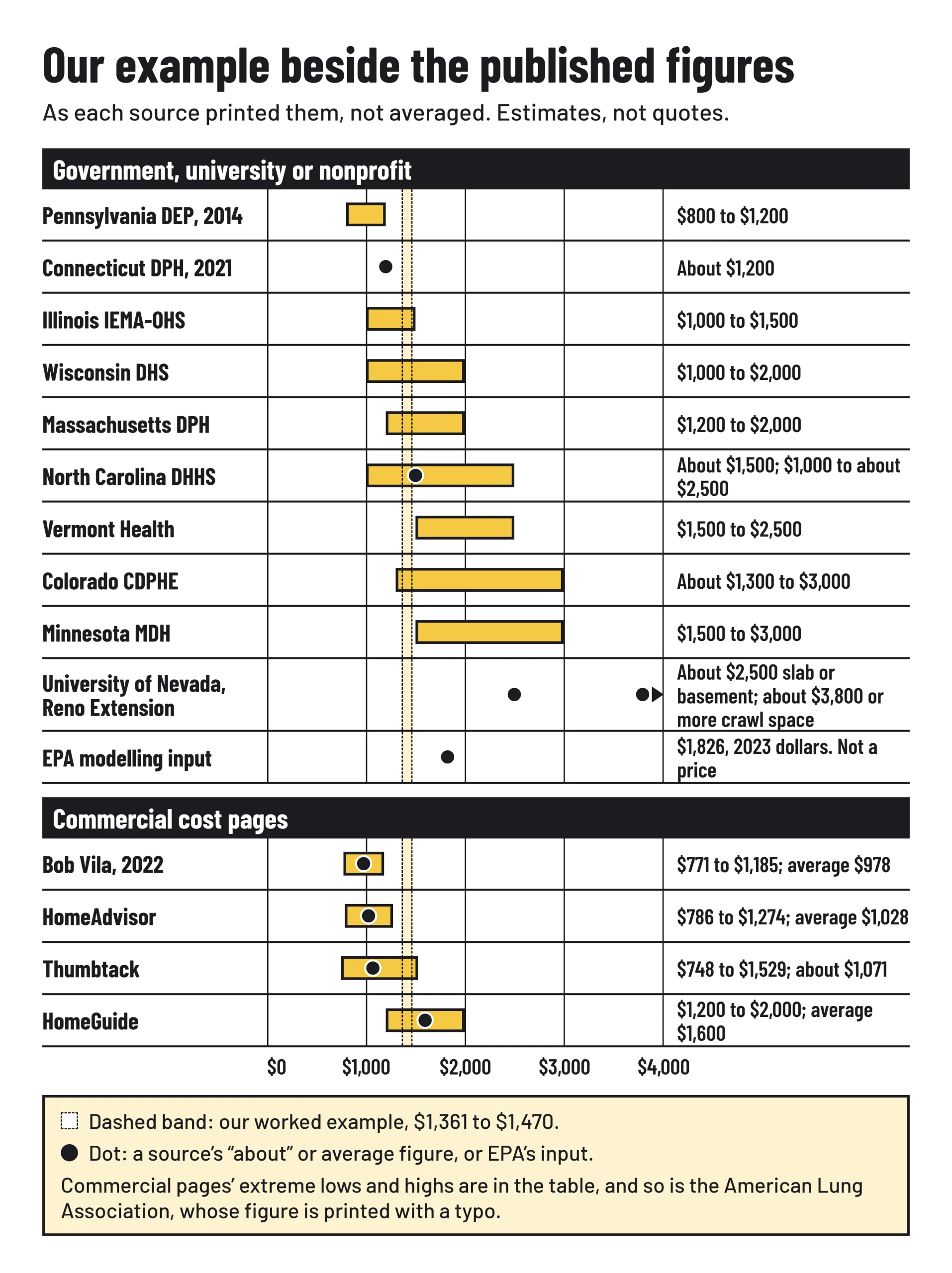
These are published estimates, each with what it says it measures. We haven’t averaged them, because they cover different years, places and jobs, and none of the agencies states a method.
| Government, university or nonprofit source | Figure | What it covers | Date |
|---|---|---|---|
| Wisconsin DHS | $1,000 to $2,000 | “average cost for a contractor to install” | Revised 21 Oct 2026 |
| Massachusetts DPH | $1,200 to $2,000 | “Most mitigation systems” | Updated 7 Oct 2025 |
| Vermont Health | $1,500 to $2,500 | Estimated cost of an active soil depressurization system | January 2024 |
| Minnesota MDH | “$1,500 to $3000” | General figure | Page updated 3 Oct 2024 |
| Colorado CDPHE | About $1,300 to $3,000 | Traditional systems on existing single-family homes | Undated |
| North Carolina DHHS | About $1,500; $1,000 to about $2,500 | Contractor average and range | Undated |
| Illinois IEMA-OHS | $1,000 to $1,500 | Active system, installation | Undated |
| University of Nevada, Reno Extension | About $2,500; about $3,800 or more | Slab or basement home; crawl space home | 2022 |
| Connecticut DPH | About $1,200 | Approximate cost in Connecticut | 2021 |
| Pennsylvania DEP | $800 to $1,200 | “most installations” | January 2014, so old |
| American Lung Association | “$1,00 – $2,500 or more” | Printed with that typo; almost certainly $1,000 | Updated 21 Oct 2026 |
| Commercial cost page | Figure | Basis it gives | Date |
|---|---|---|---|
| HomeGuide | $1,200 to $2,000; average $1,600; low $500; high $8,000 | “research and project costs reported by HomeGuide members”. Offers estimates from pros | 5 Feb 2026 |
| Thumbtack | $748 to $1,529; about $1,071; low $438; high $2,548 | “data provided by Thumbtack pros and additional research”. Sells introductions to pros | Updated 9 Apr 2026 |
| Bob Vila | $771 to $1,185; average $978; up to $3,000 | Cites HomeAdvisor. Links to a quote service | Updated 29 Jul 2022 |
| HomeAdvisor | $786 to $1,274; average $1,028 | Links to “How we get this data”, which we didn’t read. Offers project quotes | Updated 19 Jun 2026; its title says 2025 data |
EPA has a figure of its own, though it isn’t a price. For a 2025 cost analysis, EPA used $1,826 for an active soil depressurization system, in 2023 dollars, built from older studies adjusted for inflation. EPA says “The cost data are from the 1990s” and that regional differences may mean much higher costs in some markets. That’s a modelling input. Don’t read it as what EPA says you’ll pay.
Most of the commercial averages, about $980 to $1,070, sit at or just below the bottom of recent state ranges. HomeGuide’s $1,600 sits in the middle, and all of them are below EPA’s input. The pages as we read them don’t show which jobs are in their data, so we can’t say why.
Published figures by type of system
Most homes get some form of soil suction, which our full guide to radon mitigation systems explains. Other methods have far thinner price data. These are published estimates, and the commercial ones disagree with each other and with Vermont.
| Type | HomeGuide, Feb 2026 | Bob Vila, Jul 2022 | Vermont, Jan 2024 |
|---|---|---|---|
| Sub-slab or active soil depressurization | $1,200 to $2,000; $2,500+ larger homes | $800 to $2,500 | $1,500 to $2,500 |
| Crawl space membrane | Not priced separately; full encapsulation $3,000 to $15,000 | $800 to $3,000 | Not given |
| Drain tile suction | $900 to $1,800 | $800 to $1,700+ | Not given |
| Sealed sump | $900 to $2,500, for sealing the pit and fitting a cover | $800 to $2,500, for suction through the sealed pit | Not given |
| Block wall suction | $1,800 to $3,000 | $1,500 to $3,000 | Not given |
| Heat or energy recovery ventilator | $1,300 to $2,500 | Not given | Around $7,000 with no added ducting or electrical work |
| Removing radon from water, carbon | $1,200 to $1,800 | Not given | Around $2,000; Vermont discourages carbon systems for radon |
| Removing radon from water, aeration | $4,000 to $5,000 | Not given | Around $7,000 |
Sealing is left out on purpose. It’s a normal part of most systems, but EPA does not recommend sealing alone, and a price for it tells you little. The water rows are a separate job from an air system, and the calculator doesn’t cover them.
Our worked estimate
The example is a basement or slab home with one suction point and about 30 ft of 3-inch pipe up the outside of the house. Each figure matches a default in the calculator. This is one retail snapshot, not a recommendation of any product, and installers buy their own parts at their own prices.
Materials
- Fan: $154.00, a 4-inch inline radon fan listed by HVAC Quick on 4 Nov 2026. The right model depends on the house and the installer’s tests, which is why we don’t size one.
- Couplings: 2 × $14.40 = $28.80, plus a U-tube gauge at $13.40 and a fan alarm at $59.00, all from the same seller’s parts list.
- Pipe: 3 lengths of 10 ft, 3-inch Schedule 40 at $26.40 from Sutherlands = $79.20. A Home Depot search excerpt showed $56.67 for a similar length, though we couldn’t open the page. Three at that price come to $170.01, so we show both.
- Small parts: $100 for fittings, sealant, clamps, roof flashing, wire and a disconnect. That’s our assumption.
- Follow-up test: $20, the short-term kit from National Radon Program Services at Kansas State, read 4 Nov 2026. New Jersey adds a $10 state fee. Check it’s still available.
Materials come to $454.40 at the low pipe price and $545.21 at the high one.
Labor
BLS has no occupation for radon installers. As our own stand-in we use the May 2025 median wages for plumbers ($30.67 an hour), construction laborers ($22.66) and electricians ($30.38). The $22.66 is the laborers-only figure in BLS wage data, which the linked page lists as $47,120 a year; the $22.44 at the top of that page covers laborers and helpers together. All of these are wages, not what a firm bills. Private construction employers paid $51.96 in total compensation for every $36.13 in wages in June 2026, so we multiply by 1.44.
The hours are our assumption: 8 for an installer, 8 for a helper and 1.5 for an electrician. Massachusetts says a system “can usually be installed in less than a day”, which fits two people for a working day, but no source gives hours by trade.
- Installer: 8 × $30.67 × 1.44 = $353.32
- Helper: 8 × $22.66 × 1.44 = $261.04
- Electrician: 1.5 × $30.38 × 1.44 = $65.62
Total
Overhead and profit are 20%, our assumption, which you can change in the calculator.
| Line | Low pipe price | High pipe price |
|---|---|---|
| Materials | $454.40 | $545.21 |
| Labor, 17.5 hours | $679.98 | $679.98 |
| Overhead and profit, 20% | $226.88 | $245.04 |
| Estimate | $1,361.26 | $1,470.23 |
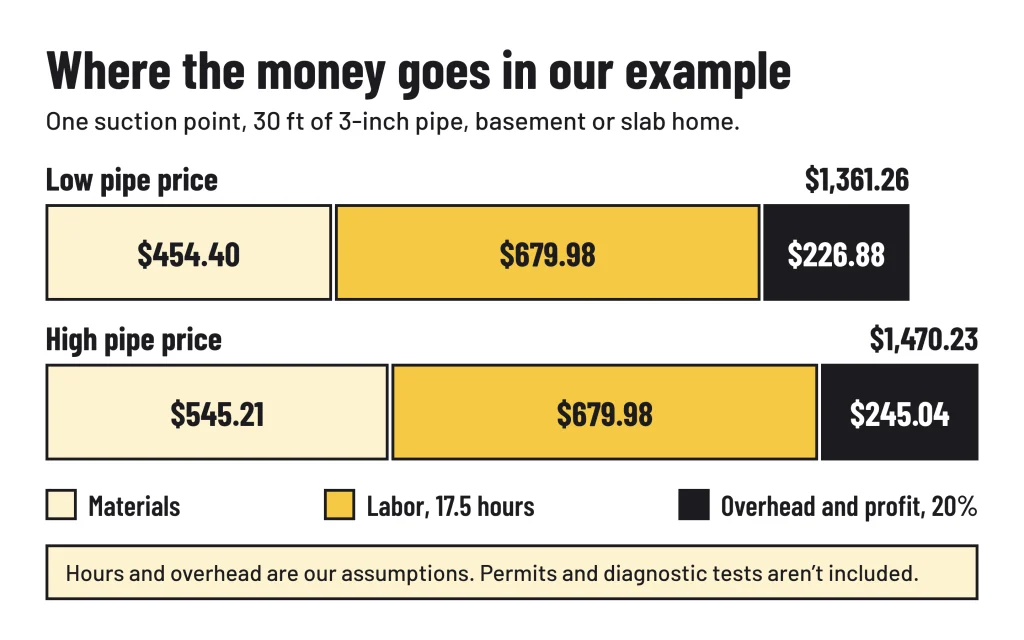
These totals land inside most of the state ranges above, though below Vermont’s and Minnesota’s $1,500 floor and above Pennsylvania’s 2014 range and Connecticut’s 2021 figure. They’re also well under Nevada Extension’s average of about $2,500 and EPA’s $1,826 input. That doesn’t confirm them: we chose hours that looked reasonable, so a match is partly built in. Permits and diagnostic tests aren’t included. Treat this as a way to see where the money goes and to question a quote, not as a fair-price verdict.
How the calculator works
Choose the foundation, then enter the suction points, pipe route and total pipe run. A contractor’s plan gives you the real numbers. Until you have one, the defaults show the example above. The tool uses these formulas:
- Pipe lengths = pipe run ÷ 10, rounded up. Pipe cost = lengths × price per length
- Membrane to buy = crawl space floor × (1 + extra %). Rolls = membrane ÷ 1,200 sq ft, rounded up. Membrane cost = rolls × roll price + membrane ÷ 100 × sealant per 100 sq ft
- Suction points = your entry, plus one if you choose a basement or slab plus a crawl space
- Materials = fan + 2 couplings + pipe + gauge + alarm + small parts + $40 for each extra suction point + follow-up test + membrane
- Installer hours = base hours + 3 for each extra suction point + 4 for the attic route. The helper gets the same, plus 2 per 100 sq ft of membrane
- Labor = (installer hours × wage + helper hours × wage + electrician hours × wage) × 1.44
- Estimate = (materials + labor) × (1 + overhead and profit %) + other items from your quote
The “compare” lines repeat Wisconsin’s range, the newest state figure we read, EPA’s modelling input and Nevada Extension’s crawl space average, so your estimate sits beside published numbers. There is no input for home size on a basement or slab job. Massachusetts lists size as a factor, but no source we read turns floor area into suction points, or suction points into a fan, and the one fan maker sheet on this point leaves the choice to a radon professional. The floor area only matters for a crawl space membrane.
What moves the price
Each row but the last changes one thing from the $1,361 example. The extra hours and parts are our assumptions, and the tool adds no hours for a longer pipe run, which is our simplification. In the last row, the second suction point is the one the tool adds for that foundation, so leave the suction points entry at 1.
| Change | Estimate | Difference |
|---|---|---|
| 60 ft of pipe instead of 30 | $1,456 | $95 more |
| High pipe price | $1,470 | $109 more |
| Overhead and profit at 30% | $1,475 | $113 more |
| A second suction point | $1,686 | $324 more |
| Pipe through the house to an attic fan | $1,730 | $369 more |
| Crawl space, 1,000 sq ft, 6 mil membrane | $2,496 | $1,135 more |
| Crawl space, 1,000 sq ft, 12 mil membrane | $2,802 | $1,441 more |
| Basement plus 1,000 sq ft crawl space, two suction points, attic route, 12 mil | $3,495 | $2,134 more |
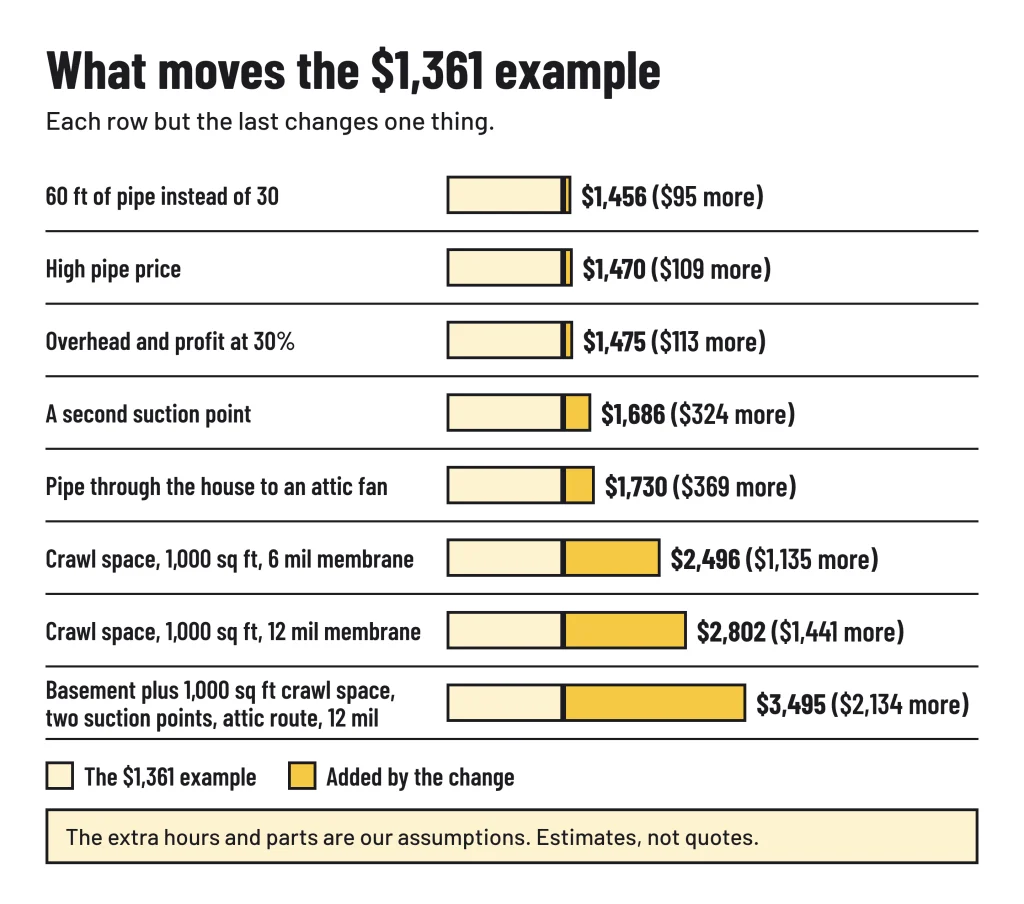
Massachusetts names the same drivers: home size, foundations, crawl spaces, floors, and the number of suction points and fans. Pennsylvania adds local market forces and the material under the slab, and EPA says a soil communication test helps show how air moves under it. EPA says the number of suction pipes depends on how easily air moves under the slab and how strong the radon source is, and that “often, only a single suction point is needed”. A contractor learns that from your house, not from a national average.
Crawl spaces cost more because someone has to lay and seal a plastic membrane over the soil, and in our build-up most of that added cost is labor. Our example assumes 23 more helper hours, and 1,150 sq ft of membrane fits on one 12 x 100 ft roll, $334.99 in 12 mil or $79.99 in 6 mil at Crawlspace Depot on 4 Nov 2026. The SGM-SF-2023 standard sets a 6 mil minimum with sealed, overlapped seams, and asks for tougher material where people will regularly walk on it. A radon membrane is also not the same job as full encapsulation, which Bob Vila puts at $1,500 to $15,000 (published estimate, July 2022): CostPlain, our sister site, has a crawl space encapsulation calculator for that. Our page on radon in a crawl space covers the method.
A home built with a passive pipe can be much cheaper to finish. Colorado says adding a fan to activate a passive radon system “should cost about $500”.
What to check on a quote
A low quote can leave things out. EPA’s Consumer’s Guide to Radon Reduction (2025 cover) gives this list, and warns that “a less expensive system may cost more to operate and maintain”. Ask whether the proposal includes:
- Proof of a state credential or a national one, such as NRPP or NRSB, which EPA calls privately run programs. EPA runs no certification program of its own.
- Proof of liability insurance, bonding and any licenses required locally.
- Diagnostic testing before design, if needed. EPA says many contractors give free estimates but “may charge for diagnostic tests”.
- A warning device, and testing after installation.
- A guarantee to reach 4 pCi/L (picocuries per liter of air, the unit on your test report) or below, and for how long. Many contractors guarantee a negotiated level, such as 2 pCi/L or less.

EPA’s guide says the contract should state the total including taxes and permit fees, the deposit, the time needed, who gets permits, and whether warranties transfer if you sell. HomeGuide and Bob Vila both put a permit at $25 to $150, which is a published estimate. Minnesota says most installations need an electrical permit. We haven’t surveyed other states.
The ANSI/AARST standard for existing homes, SGM-SF-2023, gives you more to compare. As we read it on 4 November 2026, it calls for a viewable gauge plus an active alarm on every fan system, and a fan outside conditioned or occupied space, including a basement or a garage below rooms. It also calls for a disconnect near the fan, and an exhaust at least 10 ft above the ground and away from openings. State rules can differ. Minnesota puts the fan rule simply: it “cannot be in or below a livable space”.
Radon Handbook sells nothing and refers no one, so we can’t tell you who to hire. EPA says it’s wise to get more than one estimate, and your state radon office can tell you what credentials your state asks for: EPA lists state contacts here.
Doing it yourself looks cheap on our materials list, but that list isn’t the whole picture. EPA recommends a qualified contractor and warns that without the right equipment or knowledge “you could actually increase your radon level or create other potential hazards and additional costs”. The fan’s wiring isn’t a DIY job: leave it to a licensed electrician, since SGM-SF-2023 also sets rules for the disconnect and for conduit on outdoor runs. Some states set rules for who may install: Minnesota requires radon mitigation professionals to be licensed, and a 2014 Pennsylvania sheet says professionally installed systems after occupancy need state-certified mitigators. See what the rules allow for DIY radon mitigation.
Costs after installation
| Cost | Published figure | Source and date |
|---|---|---|
| Fan electricity | $114.54 a year at 72 W, the top of one 4-inch fan’s range on its maker sheet (8/15), and 18.16 cents per kWh, our arithmetic. Electricity only | EIA US residential average, August 2026 |
| Running cost, EPA’s model | $206 a year, 2023 dollars: EPA’s “Operating Costs per Year” line, which it ties to fan electricity and upkeep | EPA analysis, Oct 2025 |
| Energy or running cost, states | “around $100 per year” (Illinois); $30 to over $100 (Pennsylvania); can reach $200 in northern climates, counting heated air (Wisconsin) | Undated; 2014; revised 22 Oct 2026 |
| New fan | “around $200 – $350 including parts and labor” | EPA Q&A, updated 23 Jun 2026 |
| New fan, EPA’s model | $476 every 10 years, 2023 dollars | EPA analysis, Oct 2025. EPA doesn’t explain the gap with its Q&A |
| Retest | $20 for a short-term kit; check it’s still available | National Radon Program Services, read 4 Nov 2026 |
EPA’s Consumer’s Guide says fans “may last for five years or more”, and that it’s “a good idea to retest your home at least every two years”. Your own electricity cost depends on your fan’s watts and your local rate: the $114.54 uses the top of one fan’s range, so a fan drawing less costs less.
Help paying for it
We found no federal or state tax credit for radon mitigation in force, as of 4 November 2026. The federal energy home improvement credit covers improvements made through December 31, 2025, and the IRS page doesn’t mention radon. We couldn’t open the final text of Iowa’s 2026 radon law, so if you’re in Iowa, ask the state radon program. Some help does exist, and all of it is limited, so check that it’s still available:
- Colorado has a low-income mitigation assistance program for homeowners.
- Massachusetts points owners in eligible rural areas to USDA Section 504 repair funding.
- Minnesota lists state housing loans, USDA repair loans and grants, and local housing agencies (page updated March 2023).
Federal grants also support state radon programs. As of 4 November 2026, federal radon funding runs on a stopgap through 11 December 2026. The President’s budget proposed ending it, and Congress hasn’t finished the FY27 bill. Your state radon office can say what it offers today. Renting? Our guide to what landlords owe tenants on radon covers the four states we found with radon laws for rentals.
Your next step
Start with the number. EPA’s Citizen’s Guide (2025 cover) says: “Fix your home if your radon level is 4 picocuries per liter (pCi/L) or higher.” It also says levels below that “still pose a risk, and in many cases may be reduced”. After a second short-term test, the same guide softens to “Consider fixing your home if the average of your first and second test is 4 pCi/L or higher”, so the wording depends on how you tested.
Our radon test result reader gives EPA’s next step for your result. Then follow EPA’s advice for the money side: “Get an estimate from one or more qualified radon mitigation contractors.” Ask each one:
- How many suction points do you plan, and why?
- Where will the fan and the exhaust go?
- What diagnostic tests are included, and do they cost extra?
- Are the alarm, permits and a follow-up test in this price?
- What level do you guarantee, for how long, and does it transfer if I sell?
This page is general information, not medical, engineering or legal advice. Prices are dated estimates, and your own quote may differ.
Sources checked on 4 November 2026.
Formulas and sources
- Crawl space included: Arithmetic on the reader's own entries, no outside figure
- Suction points counted: Arithmetic on the reader's own entries, no outside figure
- Suction points beyond the first: Arithmetic on the reader's own entries, no outside figure
- Pipe lengths: Arithmetic on the reader's own entries, no outside figure
- Pipe cost: Arithmetic on the reader's own entries, no outside figure
- Couplings cost: HVAC Quick: RadonAway parts, listed 4 Nov 2026 (retailer)
- Small parts cost: Radon Handbook build-up: hours and small parts are our assumption
- Membrane to buy: Radon Handbook build-up: hours and small parts are our assumption
- Membrane rolls: Crawlspace Depot: 12 mil liner, 12 x 100 ft, listed 4 Nov 2026 (retailer)
- Membrane cost: Crawlspace Depot: 12 mil liner, 12 x 100 ft, listed 4 Nov 2026 (retailer)
- Materials: Arithmetic on the reader's own entries, no outside figure
- Installer hours in total: Radon Handbook build-up: hours and small parts are our assumption
- Helper hours in total: Radon Handbook build-up: hours and small parts are our assumption
- Hours of labor: Radon Handbook build-up: hours and small parts are our assumption
- Labor cost: BLS Employer Costs for Employee Compensation, June 2026, construction (Table 4)
- Materials and labor: Arithmetic on the reader's own entries, no outside figure
- Overhead and profit: Radon Handbook build-up: hours and small parts are our assumption
- Estimated total: Arithmetic on the reader's own entries, no outside figure
- Wisconsin range, low end: Wisconsin DHS: Reduce Radon, revised 21 Oct 2026
- Wisconsin range, high end: Wisconsin DHS: Reduce Radon, revised 21 Oct 2026
- EPA modelling input: EPA Analysis of Benefits and Costs of Radon Reduction, Oct 2025, Table 1 (2023 dollars)
- Nevada Extension crawl space average: University of Nevada, Reno Extension, Kelly, 2022
- Employer cost per dollar of wages, construction (1.44, as of 2026-11-04): BLS Employer Costs for Employee Compensation, June 2026, construction (Table 4)
- Couplings on one fan (2, as of 2026-11-04): Radon Handbook build-up: one coupling each side of the fan, our assumption
- Square feet in a 12 x 100 ft roll (1200, as of 2026-11-04): Crawlspace Depot: 12 mil liner, 12 x 100 ft, listed 4 Nov 2026 (retailer)
- Wisconsin published range, low end (1000, as of 2026-11-04): Wisconsin DHS: Reduce Radon, revised 21 Oct 2026
- Wisconsin published range, high end (2000, as of 2026-11-04): Wisconsin DHS: Reduce Radon, revised 21 Oct 2026
- EPA modelling input for an installed system, 2023 dollars (1826, as of 2026-11-04): EPA Analysis of Benefits and Costs of Radon Reduction, Oct 2025, Table 1 (2023 dollars)
- Nevada Extension crawl space average, stated as about this or more (3800, as of 2026-11-04): University of Nevada, Reno Extension, Kelly, 2022
Sources
- EPA: How much can a radon mitigation system cost? (updated 16 Sep 2026)
- EPA: A Consumer's Guide to Radon Reduction (2025 cover)
- EPA: A Citizen's Guide to Radon (2025 cover)
- EPA: Analysis of Benefits and Costs of Radon Reduction (Oct 2025)
- EPA: How do I know if my radon mitigation system is working properly? (updated 23 Jun 2026)
- EPA: Map of Radon Zones and Supplemental Information (updated 8 Oct 2026)
- EPA: State and Tribal Indoor Radon Grants (updated 8 Jul 2026)
- ANSI/AARST SGM-SF-2023
- Wisconsin DHS: Reduce Radon (revised 21 Oct 2026)
- Wisconsin DHS: Radon-resistant construction (revised 22 Oct 2026)
- Massachusetts DPH: Fixing Radon in Your Home (Oct 2025)
- Vermont Health: Fixing Radon in Your Home (January 2024)
- Minnesota MDH: Radon Mitigation Systems (updated 3 Oct 2024)
- Minnesota MDH: Financial Assistance
- Colorado CDPHE: Radon FAQ
- North Carolina DHHS: Radon Mitigation
- Illinois IEMA-OHS: What Is Radon
- University of Nevada, Reno Extension: Radon Mitigation, Kelly (2022)
- Connecticut DPH: Basic Radon Facts (2021)
- Pennsylvania DEP: Radon Mitigation Systems fact sheet (January 2014)
- American Lung Association: Radon (updated 21 Oct 2026)
- HomeGuide: Radon Mitigation Cost (5 Feb 2026, lead-generation site)
- Thumbtack: Radon Mitigation Cost Guide (updated 9 Apr 2026, lead-generation site)
- Bob Vila: Radon Mitigation System Cost (updated 29 Jul 2022)
- HomeAdvisor: Radon Mitigation System Cost (updated 19 Jun 2026, lead-generation site)
- HVAC Quick: radon fans (listed 4 Nov 2026)
- HVAC Quick: radon parts (listed 4 Nov 2026)
- Sutherlands: 3 in x 10 ft DWV Schedule 40 pipe (listed 4 Nov 2026)
- Crawlspace Depot: 12 mil liner (listed 4 Nov 2026)
- National Radon Program Services: test kits (read 4 Nov 2026)
- RadonAway RP series sheet, 03/08, filed with NY DEC
- BLS: Plumbers, Pipefitters and Steamfitters (May 2025)
- BLS: Construction Laborers and Helpers (May 2025)
- BLS: Electricians (May 2025)
- BLS Employer Costs for Employee Compensation, June 2026, Table 4
- EIA Electric Power Monthly Table 5.6.A, August 2026
- IRS: Energy Efficient Home Improvement Credit
- Crawlspace Depot: 6 mil liner (listed 4 Nov 2026)
- EPA: How can you find a qualified radon service provider? (updated 23 Jun 2026)
- RadonAway RP series sheet, 8/15, P/N 02008
- CRS R49292: Interior appropriations, FY2027 (21 Oct 2026)
- EPA FY27 Congressional Justification: State and Tribal Assistance Grants