A radon system asks very little of you. Look at the gauge once a month, test the house for radon at least every two years, and expect to pay for a new fan at some point. EPA puts it this way: “Similar to a furnace or chimney, radon reduction systems need occasional maintenance.”
The fan is the part that wears out. EPA’s guide says fans “may last for five years or more”, and its 2025 cost model assumes one every 10 years, with the rest of the equipment lasting 74 years if properly maintained. Those are planning figures, not measurements: EPA itself says more information is needed on “potential failure rates of fans”.
This guide is the owner’s calendar: what to do and when, what it costs, and what you can skip. It’s part of our pages on living with a radon system.
The maintenance schedule
This table is for a typical fan-powered system. Installers call it active soil depressurization: a fan pulls soil gas through a pipe and vents it above the roof.
| Task | How often | Who | Whose advice |
|---|---|---|---|
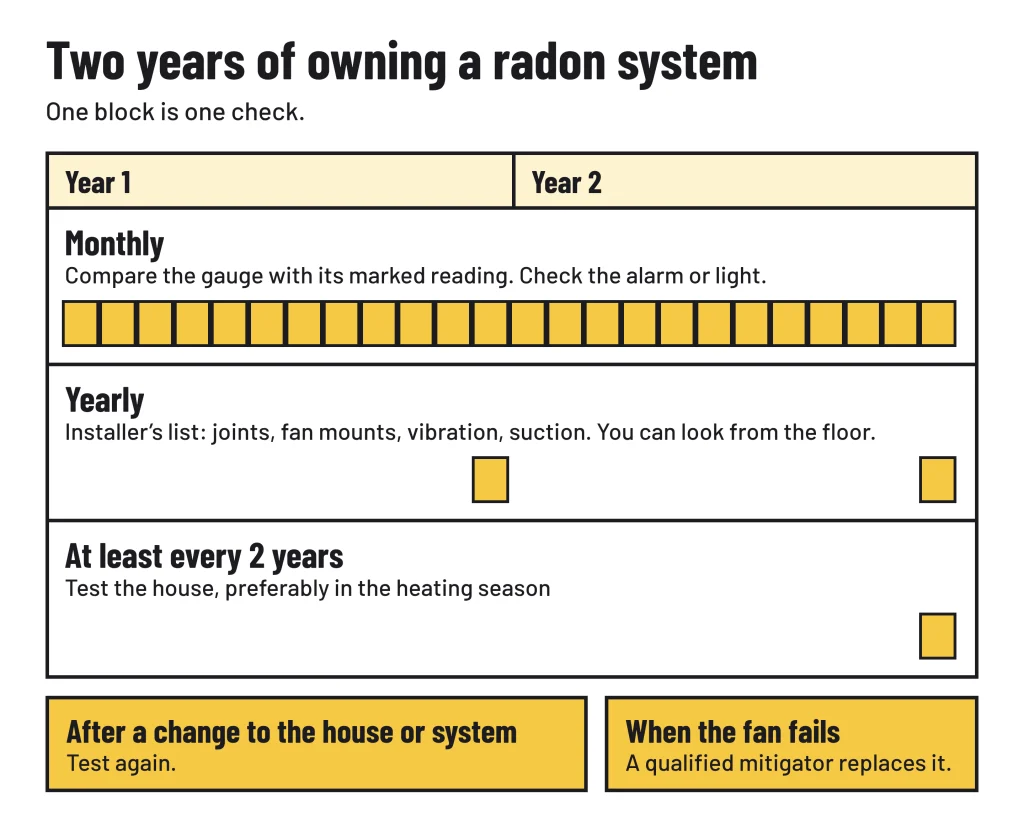
| Compare the gauge with its marked start-up reading | Monthly | You | Minnesota Department of Health form, 2023. EPA says “on a regular basis” |
| Check the alarm or light monitor and its plug or batteries | Monthly | You | Minnesota form |
| Test the house for radon | At least every 2 years, preferably in the heating season | You or a tester | EPA Q&A, updated 23 June 2026; Pennsylvania DEP; Minnesota |
| Test again after a change to the house or system | When it happens | You or a tester | Minnesota; EPA Consumer’s Guide |
| Check joints, fan mounts, vibration and suction | Yearly | Installer for the full list; you can look from the floor | Maker’s installation guide, written for installers |
| Replace the fan | When it fails | A qualified mitigator | EPA Consumer’s Guide |
Minnesota’s form applies to systems installed there, but it’s the most complete owner’s plan we read. If you have a heat recovery ventilator instead of a fan system, skip to other kinds of system.
The monthly gauge check
Most systems have a U-tube manometer: a small tube of colored fluid on the pipe. Find the mark or sticker showing the reading taken at installation, then compare.
- Fluid uneven and near the mark: there is suction in the pipe. Pennsylvania reads uneven levels as a running fan.
- Fluid even on both sides: Minnesota says the fan stopped or another part of the system isn’t working properly. Michigan’s radon specialist lists no electricity, a faulty fan, or a pipe blocked by ice, debris or a critter.
- Fluid well away from the mark: Minnesota treats a reading “significantly different” from installation as a sign the system may not be working properly.
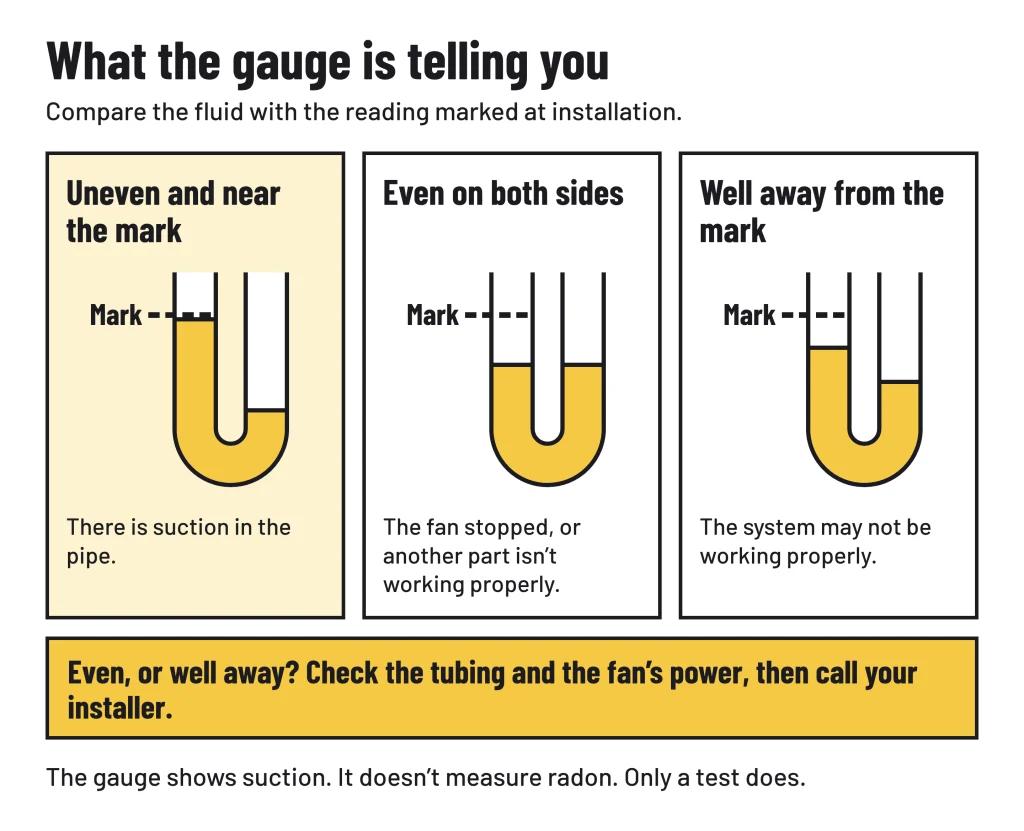
Before calling anyone, make two checks from Minnesota’s and Michigan’s lists: that the small gauge tubing is attached and not kinked, and that the fan has power, meaning the breaker hasn’t tripped and the fan isn’t unplugged. If that doesn’t explain it, call your installer. Leave the wiring and the fan housing alone.
There’s no universal correct number. The right fluid height depends on your house and your fan, and ANSI/AARST SGM-SF-2023, an installation standard for existing homes, has installers mark start-up values on the monitor. Pages online give “normal” figures that conflict. Your own marked reading is what counts. Our guide to reading a radon manometer goes through it step by step.
Remember what the gauge can’t tell you. “The mitigation system manometer does not measure radon concentrations,” Michigan’s Leslie Smith III says. “The only way to know the radon concentrations in a building is to conduct a radon test.” A steady gauge shows suction. It isn’t a radon result.
And don’t switch it off to save power or quiet it down. In EPA’s words, “the fan should NEVER be turned off; it must run continuously for the system to work correctly.” One maker’s 2021 guide adds that a fan left on the pipe without power for more than 48 hours can fail.
One monitor or two? The sources differ. EPA’s Consumer’s Guide asks for one warning device, and a liquid gauge counts. Minnesota requires two: a U-tube and an active alert. SGM-SF-2023 likewise calls for a viewable monitor plus a sound, light or remote alert on the systems it covers. If yours has only a U-tube, it matches EPA’s description, but it warns you only when someone looks at it. For scale, HVAC Quick listed a system alarm at $57 and a battery air-flow alarm at $59 on 4 November 2026, parts only. Ask an installer before adding one: the standard says a monitor shouldn’t share the fan’s circuit unless something else warns you when that circuit loses power.
The two-year radon test
This is the check that counts most, because it’s the only one that measures radon. EPA: “It is a good idea to retest your home at least every two years to be sure radon levels remain low.” Michigan, which says the same, includes passive systems.
Pennsylvania and Minnesota both prefer the heating season. Our home testing guide covers kit placement and closed-house conditions. For cost, the National Radon Program Services at Kansas State University listed kits at $20 short-term and $30 long-term, costs included, on 4 November 2026; New Jersey adds a $10 state fee on short-term kits. Check it’s still available; your state radon office may have other offers.
Don’t wait for the two-year mark after a change. Minnesota’s list calls for a test after any of these, and with any sale of the building:
- An addition, or a new adjoining structure or parking area
- Remodeling or reconfiguring the building
- Moving into a ground-contact area that hasn’t been tested, or a home being newly occupied
- Heating or cooling changes that alter air distribution or pressure
- Extensive weatherization
- New sumps, drain tile, sewer lines or shower and tub work, or major settling cracks
- Earthquakes, blasting, fracking or sinkholes nearby
- Any change to the mitigation system itself
EPA adds that after remodeling you should retest in the lowest lived-in area.
Put your number into our test results tool for EPA’s next step. If a home with a system tests at 4 pCi/L (picocuries per liter) or higher, Minnesota says additional work may be needed, so call your installer. Between 2 and 4, EPA’s advice is to consider fixing, and Minnesota’s form says the same. EPA says levels below 4 still pose a risk: 4 is its action level, a decision point and not a safety line.
Once a year
The only yearly list we found is in a maker’s guide. RadonAway’s installation guide (October 2021, read in a copy posted by a manuals site; the August 2015 edition has the same list) has a section on “Operation Checks & Annual System Maintenance”. In short: connections tight and leak-free, fan and ducting secure and free of vibration, suction within the normal range and under the fan’s maximum, and radon levels verified by a test. It’s written for installers, so read it as a checklist for a service visit.
What you can do from the floor and the yard, without opening anything or climbing on the roof:
- Walk the visible pipe. Look for cracks, separated joints and loose supports.
- Listen for a change in the fan’s sound, or for vibration.
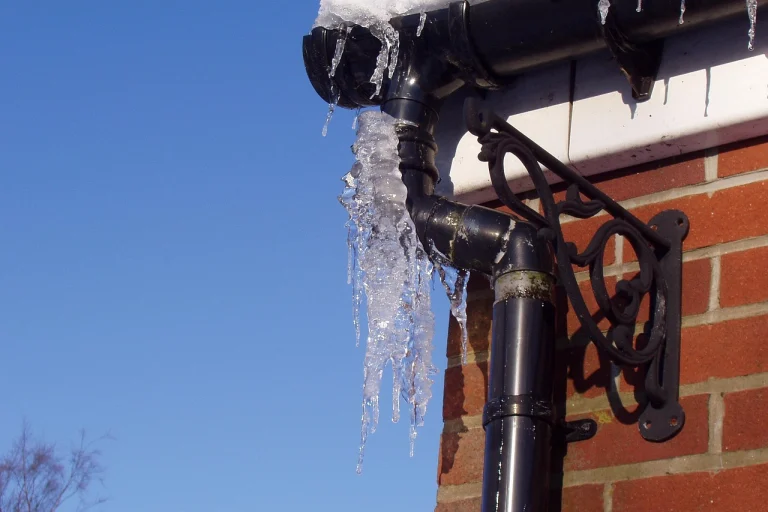
- Look at the exhaust from the ground for ice, nests or debris.
- Check the labels are still readable. EPA says systems must be clearly labeled so nobody changes them by accident.
- Tell any plumber, roofer or remodeler that the pipe is a radon system and shouldn’t be moved or cut. If it is altered, test again.
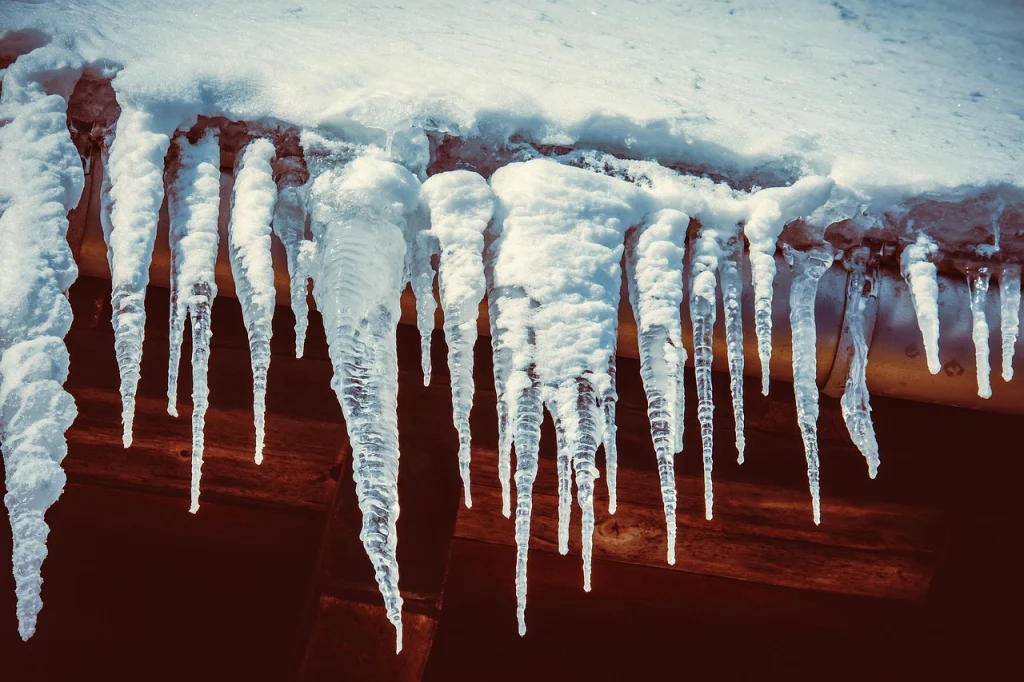
Some moisture is expected. The maker’s guide says condensation forms where the pipe runs through cold space and has to drain back down the pipe. Ice is the bigger winter issue: Minnesota’s form says freeze-ups stop the pipe venting properly and raise radon levels, the gauge will read even, and if it happens regularly the pipe needs insulating or other changes by your installer.
How long a radon system lasts
No public study we found measures how long home radon fans really last. The numbers below measure different things, so we’ve kept them apart.
| Source | Fan life | What it is |
|---|---|---|
| EPA Consumer’s Guide | “may last for five years or more” | Consumer guidance. Text unchanged since 2016, 2025 cover |
| EPA cost analysis, October 2025 | Replaced every 10 years; 5 years also tested | Modeling assumption, not field data |
| Pennsylvania DEP fact sheet, January 2014 | “will typically last much longer” than a five-year warranty | State fact sheet, old, no figure |
| Fantech leaflet, undated | “Average life expectancy of 7-10 years under continuous load conditions” | Maker’s claim for the motor, older model line |
For the whole system, EPA’s model uses 74 years if properly maintained and replaces the warning device at year 37. That’s an input to a program-level cost analysis, not a promise for your house, and EPA says the program still comes out ahead if the real life is well below 74. Pages online give their own figures for the system and the pipe, often decades. None we found showed data, so treat those as claims.
The practical reading: budget for the fan as a repeat cost, and let the gauge and the test tell you when. Nothing we read tells owners to replace a working fan on a schedule; EPA’s 10 years is a model assumption. Radon levels can change too, as Minnesota’s form notes, which is why the test matters.
What upkeep costs
EPA’s guide gives no price for a new fan, but an EPA Q&A does. Every figure here is dated and will change.
| Item | Figure | Source and date |
|---|---|---|
| Electricity, 20 W small fan | $31.82 a year | 175.2 kWh at 18.16¢, EIA US residential average, August 2026, a summer month, preliminary. 20 W is Minnesota’s “small fan” example |
| Electricity, 72 W fan | $114.54 a year | 630.7 kWh, same rate; top of the range on a maker’s August 2015 sheet for one 4-inch fan |
| Electricity, 140 W fan | $222.71 a year | 1,226.4 kWh, same rate; top of the range on a maker’s September 2012 sheet for one high-suction fan |
| Radon test | $20 short-term, $30 long-term | Kansas State program, 4 November 2026 |
| New fan, installed | “around $200 – $350 including parts and labor” | EPA Q&A, updated 23 June 2026; no year or method given |
| New fan, EPA’s model | $476 every 10 years | EPA analysis, 2023 dollars; EPA says its cost data are from the 1990s |
| Fan alone, for scale | $154 | HVAC Quick listing for that 4-inch fan, parts only, 4 November 2026 |
EPA doesn’t explain the gap between its two fan figures. Its guide says to ask qualified mitigators for estimates before work begins.
Here’s a worked year for a 72 W fan at the US average rate. The fan’s life, and which test and fan prices go with it, are our assumption, so swap in your own. The 72 W is the top of that fan’s range, so a fan running lower costs less:
| Yearly cost | Fan lasts 10 years | Fan lasts 5 years |
|---|---|---|
| Electricity | $114.54 | $114.54 |
| Test every 2 years | $10.00 ($20 kit) | $15.00 ($30 kit) |
| Fan | $20.00 ($200 fan) | $70.00 ($350 fan) |
| Total a year | $144.54 | $199.54 |
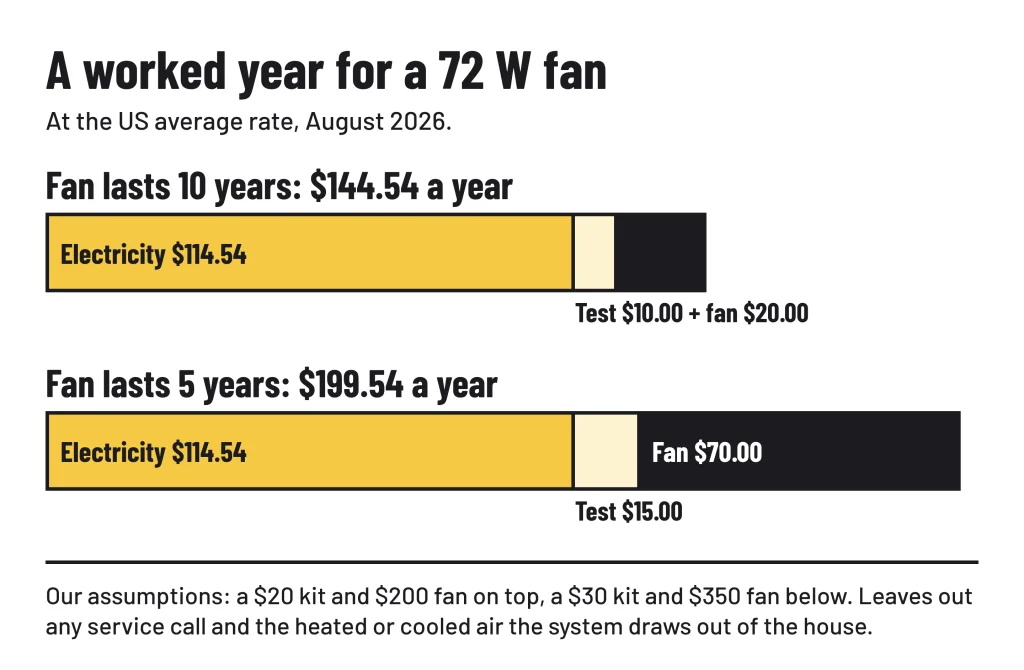
Your own wattage and rate change the answer most, and our fan running cost calculator works it out. This total leaves out any service call and the heated or cooled air the system draws out of the house, which Minnesota’s form notes as a separate cost.
Published figures for comparison: EPA’s model lists $206 a year in operating costs in 2023 dollars, with the fan on its own line, and says its operation and maintenance costs cover fan electricity and fan replacement. Wisconsin (revised 22 October 2026) says fan energy plus heating the replacement air “can cost $200 per year in northern climates”. Illinois says around $100 a year for energy, undated. Pennsylvania said $30 to over $100 in 2014.
Warranties and guarantees
These are three different promises. Read your paperwork for each.
- The fan warranty, from the maker. EPA says these “tend not to exceed five years”. RadonAway’s October 2021 guide gives 12 months from purchase, or 18 from manufacture if that’s sooner, extended to 60 and 66 months when a professional radon mitigation contractor installs the fan. It says the company isn’t responsible for installation, removal or delivery costs, and that the owner pays to return the fan. So a covered fan can still leave you with a labor bill.
- The installer’s warranty on parts and labor. Minnesota’s form has the installer fill in years for each.
- The radon guarantee. This is a promise to keep levels under a number for a set time. Minnesota’s form also allows “not guaranteed”, so check which box applies to you.
Two checks from EPA’s guide: ask whether warranties are transferable if you sell, and ask before major remodeling whether the changes could void them. Sales pages sometimes promise a “lifetime warranty”. Treat that as a claim until you’ve read in writing what it covers, for whom, and who pays the labor.
Do you need a yearly service visit?
Some installers say you do. They also sell those visits. For a fan system, the maker’s yearly list above is the only schedule we found. EPA’s Consumer’s Guide and Minnesota’s form set no paid inspection interval for one, and we found no federal or state rule that requires one, though we didn’t read every state’s. The owner’s jobs are the gauge and the test. A heat recovery ventilator is the exception: EPA asks for a yearly professional check, covered below.
Book a visit when you have a reason:
- The gauge moved or the alarm sounded, and power and tubing aren’t the cause.
- The fan got noisy or stopped.
- A test came back higher than before.
- You bought a house with a system and have no records.
If you do book one, ask what will be measured and for the readings in writing.
Other kinds of system
Heat recovery ventilator. This one needs the most upkeep. EPA says the filter needs periodic cleaning and should be changed twice a year (replacements at $10 to $25, a price in the guide since 2016), the outdoor intake needs checking for leaves and debris, and a heating and cooling professional should check the air balance every year. It should run all the time when used for radon control.
Passive system. With no fan, there’s no manometer to read. The test is your only check, so don’t skip it. More in our guide to passive radon systems.
Crawl space membrane or sealed sump. The sources we read set no schedule. If a plastic membrane is torn or pulled back, or a sump lid is left off after pump work, ask your installer to restore it, then test.
If the fan fails
Gauge and alarm trouble is covered above. Two other signs: a new noise or vibration, and a fan cycling on and off while water stands at slab level. The maker’s guide says water can rise in the pipe, block the cooling air and trip the thermal cutoff. Either way, call your installer. If the fan is past repair, see our guide to replacing a radon fan.
Fans, wiring and pipes run through a house, and some states regulate who may do this work, Pennsylvania among them as of its January 2014 fact sheet. Check with your state radon office before doing any of it yourself. EPA doesn’t certify anyone: it points to state programs and two privately run national proficiency programs, NRPP and NRSB.
Keep a one-page record
A buyer, a new installer or you in eight years will want these. Minnesota’s form has blanks for most of them:
- Installer’s name, company, phone and license or credential number
- Installation date, fan model and fan location
- The start-up gauge reading
- Suction point locations and any valve settings
- Every radon test: date, location, result
- Warranty and guarantee terms
- Dates of any fan replacement or system change
Bought a house with no paperwork? Start with the label on the pipe. SGM-SF-2023 asks for installer contact details there and for contractors to keep records at least six years, so a call may recover them.
What EPA says to do next
EPA’s advice for owners fits in three lines. Look at your warning device “on a regular basis to make sure the system is working correctly.” Retest “at least every two years”. And “if your monitor shows that the system is not working properly, call a contractor to have it checked.”
If you’re calling an installer, ask:
- What should my gauge read, and is it marked?
- Which parts and labor are still under warranty, and does the warranty transfer?
- What will you measure, and will you put the readings in writing?
- Do you recommend an independent test after the work?
If it’s been more than two years, or you don’t know when the house was last tested, that test is your first step.
Radon Handbook sells nothing and refers no one. This page is general information, not medical, engineering or legal advice.
Sources checked on 4 November 2026.
Sources
- EPA: A Consumer's Guide to Radon Reduction (2025 cover)
- EPA: A Citizen's Guide to Radon (2025 cover)
- EPA: How do I know if my radon mitigation system is working properly? (updated 23 June 2026)
- EPA: Analysis of benefits and costs of radon reduction (October 2025)
- EPA: Find a radon test kit or measurement and mitigation professional (updated 30 December 2025)
- EPA: Map of Radon Zones and Supplemental Information (updated 8 October 2026)
- Minnesota Department of Health: Radon Mitigation System Important Safety Information, OM&M plan (2 October 2023)
- Michigan EGLE: Even homes with radon mitigation systems should test every two years (29 January 2025)
- Pennsylvania DEP: Radon in the Home
- Pennsylvania DEP: fact sheet 2940-FS-DEP4430 (January 2014)
- Wisconsin DHS: Radon-resistant construction (revised 22 October 2026)
- Illinois IEMA-OHS: What is radon (undated)
- ANSI/AARST SGM-SF-2023
- RadonAway: RPc, GPc, XPc, XR installation guide, IN096 Rev C, October 2021 (third-party copy)
- RadonAway: RP Series installation instructions, IN020 Rev R, August 2015
- RadonAway: RP Series sheet, August 2015
- RadonAway: GP Series sheet, September 2012
- Fantech: HP series leaflet (undated)
- EIA Electric Power Monthly, Table 5.6.A (August 2026 data, released 23 October 2026)
- National Radon Program Services, Kansas State University: test kits (read 4 November 2026)
- HVAC Quick: radon fan listing (read 4 November 2026)
- HVAC Quick: parts listing (read 4 November 2026)