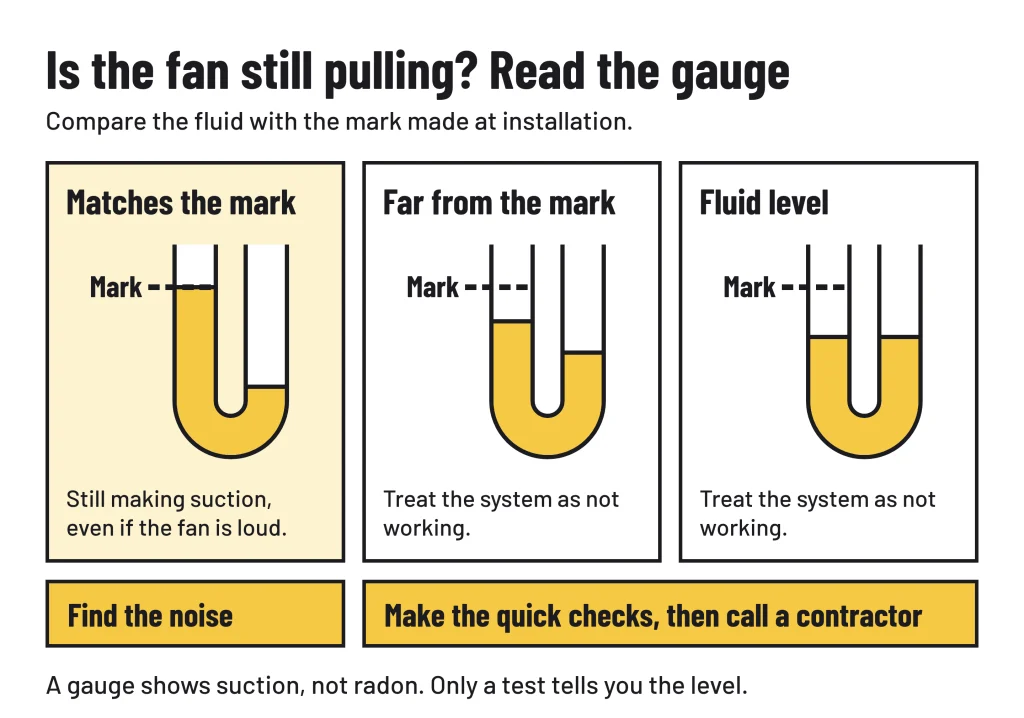
Radon fan repair starts with one question: is the fan still pulling? Look at the U-tube gauge or the alarm before you think about the noise. If the fluid sits level, the reading has moved well away from the mark made at installation, or a low-suction alarm is sounding, treat the system as not working. Make the quick checks below, then call a contractor. If the fan is loud but the reading still matches the mark, it is still making suction, and the job is finding the noise.
There is little to fix inside the fan itself. RadonAway’s manual says there are “no user serviceable parts” inside, so most repairs are to what surrounds the fan, or the fan gets replaced. This page is part of our guide to living with a radon system.
Start here: what are you seeing?
| What you notice | What it can mean | Go to |
|---|---|---|
| Fluid level, fan silent | No power, or the fan has failed | The owner checks |
| Fluid level, fan running | Tube off or kinked, a blocked pipe, or another part of the system | The owner checks, then call |
| Fluid level during a long cold spell | Ice in the pipe | Frozen pipe |
| Reading far from the installer’s mark | The system may not be working properly | The owner checks, then call |
| Alarm beeping or flashing | Low suction, or only a low battery | Read the alarm |
| Fan starts and stops by itself | The motor may be overheating and cutting out | Fan cycling |
| New noise, reading unchanged | Mounting, air speed, water or wear | Noise by sound |
A gauge shows suction, not radon. Minnesota’s owner form says this monitor “does not show or measure radon levels“. It tells you the fan is doing its job, and only a test tells you the level. If you are not sure how to read yours, see how to read a radon manometer.
Fan stopped: the owner checks
Minnesota’s form, which installers there attach to each system, is the clearest public instruction we found. It says: “If the fluid levels are even, it means the fan stopped working or another part of the system is not working properly.” It treats a reading “significantly different” from the installed mark the same way, without giving a number. It then names two checks to make before calling: that the monitor tubing is connected and not kinked, and that power is reaching the fan. The sample system label in SGM-SF-2023 lists the same order: the gauge hose, the switch or breaker, then a call for service.
- Look at the small tube running from the gauge to the pipe. If it has slipped off, split or been pinched, the gauge can read level on a working fan.
- Check the breaker. If it has tripped, reset it once. If it trips again, don’t keep resetting it. Call an electrician.
- Find the switch near the fan. The current standard, ANSI/AARST SGM-SF-2023, puts a disconnect within sight of the fan and within 6 feet of it, though it allows a remote switch where accidental shutoff is a concern. Older systems may differ. Someone may have turned it off during other work. If it is off and no work is under way, switch it back on.
- Check the plug, if there is one. Minnesota says a fan is “plugged into an electrical junction box or hard wired“. Look only. Don’t open a junction box.
- Listen for the fan from the ground or the attic hatch. Stay off the roof.
Stop there. Anything further is wiring or the fan itself. RadonAway’s manual says “All wiring must be performed by a qualified and licensed electrician“, and both it and Fantech’s manual say to switch off and lock out the power at the panel before any service.
Don’t let it wait for a convenient month. Besides what a stopped fan means for your radon level, RadonAway warns against leaving a fan on the pipe without power for more than 48 hours, because “Fan failure could result“. EPA gives no deadline, and we found no primary source on how fast levels rise after a fan stops. EPA’s instruction is simply to call.
Read the alarm
Alarms differ, so check the leaflet for yours. As an example of what the sounds can mean, the manual for one battery alarm (RadonAway RSA1, IN098 Rev H) lists these:
- One chirp and a flash every 5 minutes: low battery, not a system fault.
- Red light blinking every 60 seconds, no sound: low or no suction sensed, and the delay is running.
- Beeps with a flashing red light, then 60 seconds of quiet, repeating: the delay has run out and suction is still low or gone.
- Beeps with a flashing blue light, then 60 seconds of quiet, repeating: service mode, after three low-suction events within the delay period.
- Hush button: silences the sound for 7 days. The light keeps flashing, and the sound returns after 7 days if the fault is still there.
Two details in that manual matter. The alarm has a selectable delay of 48 hours (the default), 7 days or 30 days before the sound starts, so a fault may be days old when you first hear it. And that model reacts to a drop of 90% or more from its baseline pressure, so a partial decline can stay silent. That is one reason to compare the gauge with its mark, not just wait for a beep.
A quiet plug-in alarm proves little, because one on the fan’s circuit can lose power along with the fan. Minnesota’s form says to check a monitor’s power source monthly. SGM-SF-2023 says a monitor shouldn’t share the fan’s circuit unless something independent, such as a battery backup, warns of lost power. It also calls for both a viewable monitor and an active alert, with an exception for remote electronic monitoring. EPA’s Consumer’s Guide (2025 cover) lists either as an example of one warning device. If you have only one, ask about the other at the service visit.
Frozen pipe in a cold spell
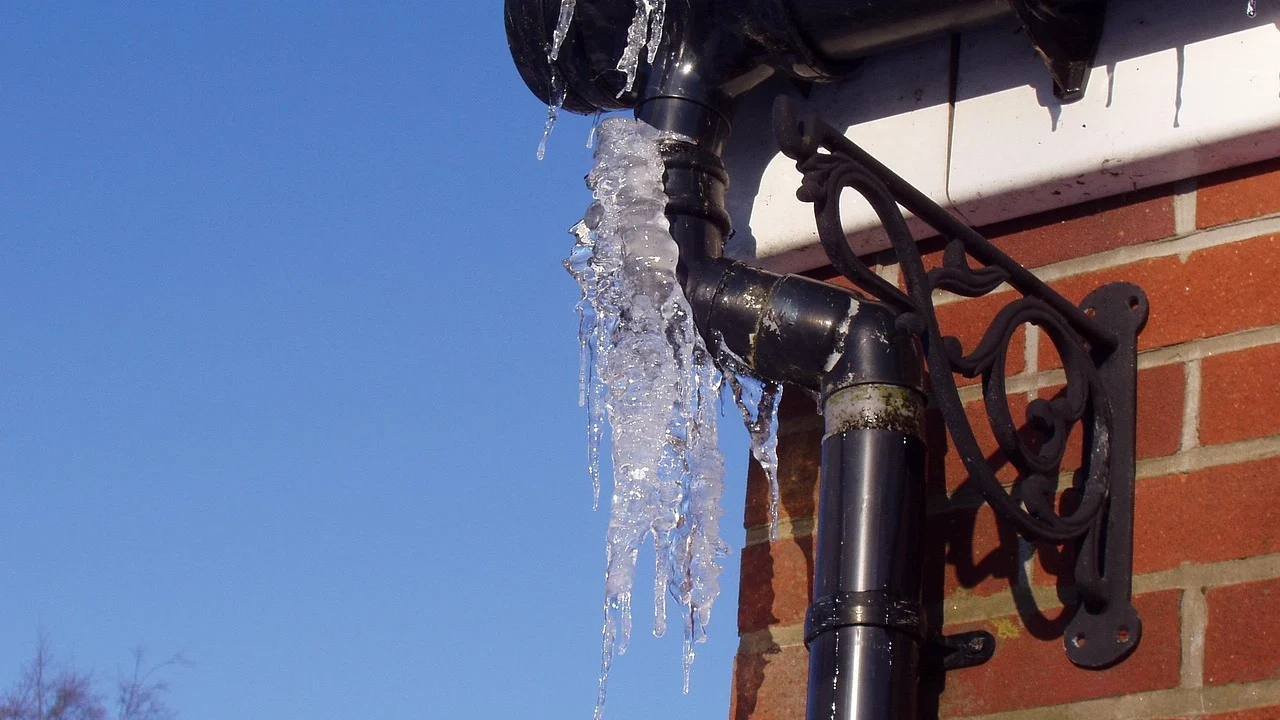
Minnesota calls this a system freeze-up: ice builds up in the pipe during long cold periods and stops the system venting properly. Its form says radon levels in the building will increase if this happens, that the fluid will be even and that the active monitor should alert you. It says to call the installer.
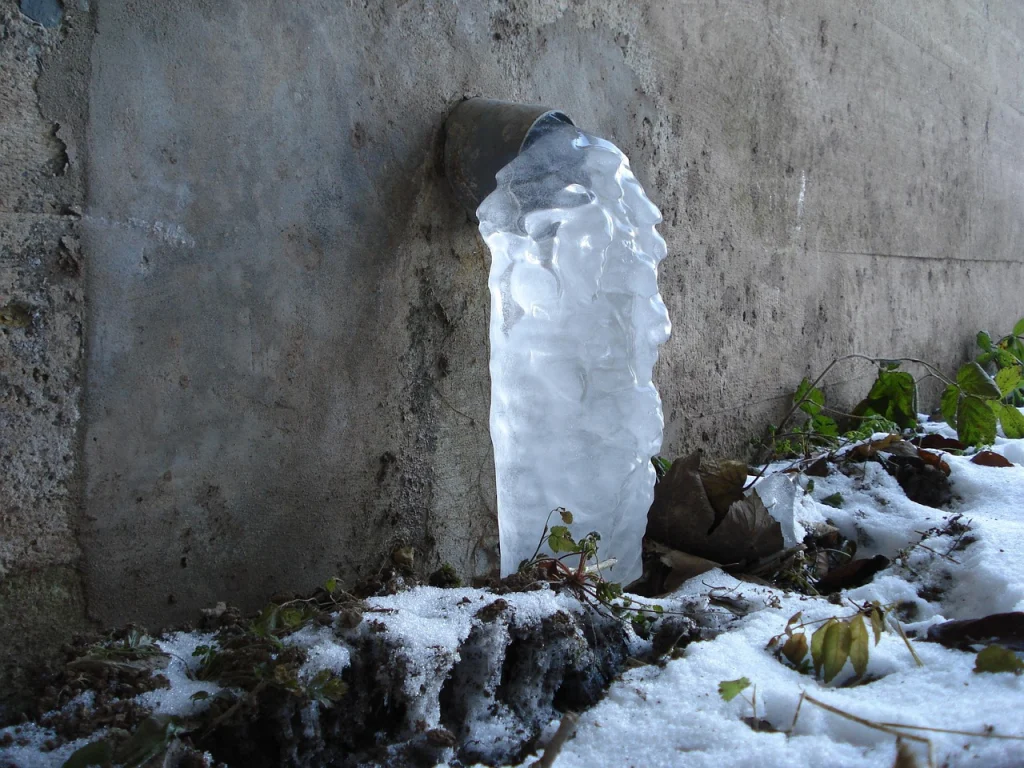
Minnesota says that if it happens “on a regular basis (annually or every few years)”, the pipe needs insulating in unconditioned areas or other changes. SGM-SF-2023 likewise calls for insulation of at least R-4 where regular ice buildup is likely to affect the system. No source we read gives owners a way to thaw a pipe, so we don’t offer one. Don’t climb an icy roof or poke at the exhaust.
Fan cycling on and off
RadonAway’s fans have a thermal cutout, which stops the motor when it gets too hot, and the manual describes one cause. A high water table puts water at or above the slab, water is drawn into the pipe and blocks the air, and without cooling air the fan may cycle on and off. Its current RPc, GXc and XPc manual (IN167 Rev B, file dated January 2026) says the same. We found no maker list of other causes, so have any cycling fan checked.
Here the sources pull in different directions. RadonAway recommends turning the fan off until the water recedes. EPA says “the fan should NEVER be turned off“. RadonAway’s manual also warns against more than 48 hours without power. So don’t make that call alone: phone the installer, say there is water at the slab, and ask what to do. For the water itself, our sister site Lowest Floor explains where basement water comes from.
Radon fan noise, by sound
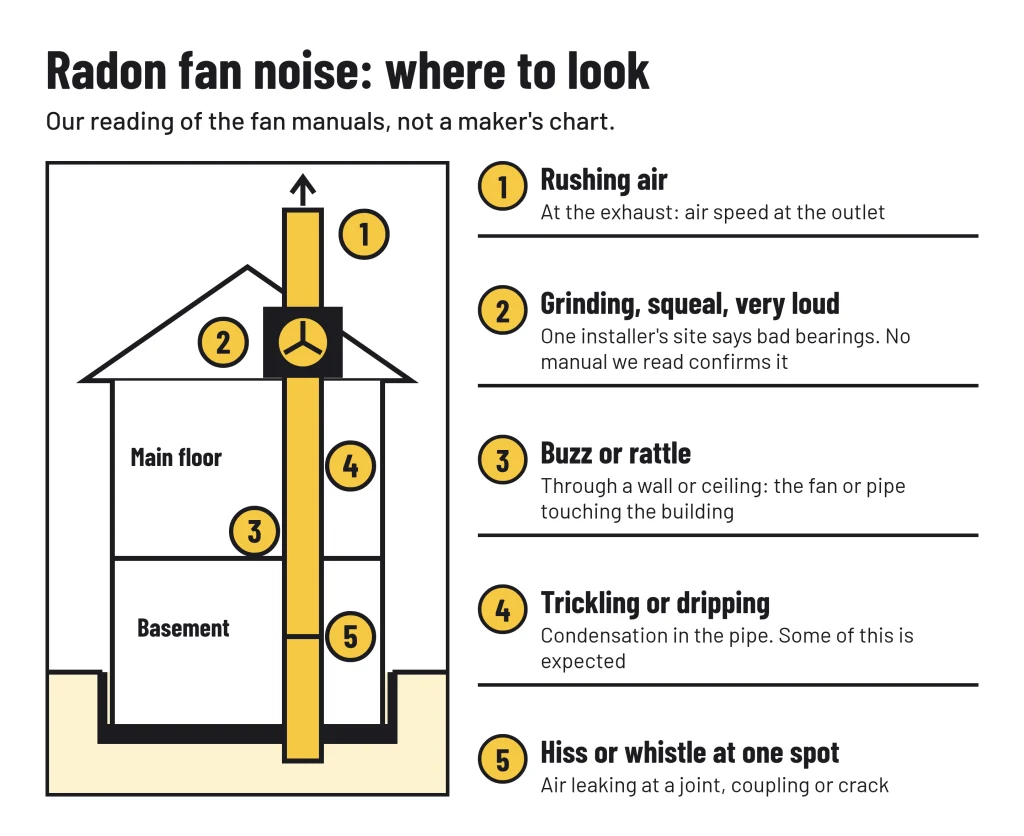
RadonAway says a properly installed fan runs with “little or no noticeable noise” to the people in the house. That is the maker’s claim. See what’s normal for a radon fan. SGM-SF-2023 asks installers to reduce objectionable vibration and rushing-air noise where practical, so a new noise is worth raising. No manual we read has a sound-by-sound chart, so this table is our reading of the manuals’ installation sections, and installer statements are labelled.
| Sound | Likely source | What to do |
|---|---|---|
| Rushing air at the exhaust | Air speed at the outlet. RadonAway says this may be disturbing in some cases | Ask the installer about an exhaust muffler, which normally goes at the end of the vent pipe |
| Buzz or rattle through a wall or ceiling | The fan or pipe touching the building. The manual says the fan must not contact any building surface | Have it isolated: flexible couplings, and foam or rubber grommets at a bracket |
| Trickling or dripping in the pipe | Condensation. The system must let water drain back to the slab hole, and it drains through the fan, so some of this is expected | Call if water leaks out at a joint or fan, or if it is getting worse |
| Hiss or whistle at one spot | Our reading: air leaking at a joint, coupling or crack | Note the spot and call. Duct tape isn’t an accepted seal, the manual says |
| Grinding, squeal or a fan gone very loud | One installer’s site says bad bearings, and blames ground moisture reaching the bearings and motor. That is an installer’s claim, and no manual we read confirms it | Check the reading, book a look, and expect a possible replacement |
Leaks after the fan matter more than the sound they make. That part of the pipe is under pressure, and SGM-SF-2023 keeps fans out of living spaces because a failed joint there could leak soil gas into rooms. Pipe rules are on our page on radon pipes and vents.
Water noise can trace to the install. RadonAway says the fan must sit plumb and level with the outlet up, that thin-walled pipe and aluminum downspout normally make much more condensation than Schedule 40, and that some cold-climate outdoor systems need a condensate bypass. Ask whether any of that applies.
Three ways not to quiet a fan
- A speed control. RadonAway says they are generally not recommended. Fantech says “Do not use these fans with any solid state speed control device.”
- Switching it off at night. EPA says it “must run continuously for the system to work correctly”.
- Anything in or over the exhaust. Never block the pipe.
Can a radon fan be repaired?
Usually not from the inside. RadonAway’s manual says “Do NOT attempt to open” and to return the unit to the factory for service, and its warranty doesn’t apply where repairs have been attempted by others. Some web guides suggest swapping a capacitor. Fantech’s wiring diagram shows one, but no maker manual we read gives a repair procedure, so we don’t give one here.
What does get repaired is everything around the fan: the gauge tube, wiring, couplings, a leaking joint, pipe insulation, a condensate bypass, the alarm. If the fan itself has failed, the usual fix is a new one.
EPA says fans “may last for five years or more“, that warranties tend not to exceed five years, and that fans “may then need to be repaired or replaced”. For a 2025 cost analysis it assumed a replacement every 10 years, which is a modelling input, not a promise. More on upkeep is in radon system maintenance and how long it lasts, and the swap itself is covered in our guide to swapping a radon fan.
Check the warranty first
- RadonAway: the current RPc manual (IN167 Rev B, file dated January 2026) gives 12 months from purchase or 18 from manufacture, whichever is sooner. If a professional radon mitigation contractor installed the fan, in the continental US or Canada, that extends to 5 years from purchase or 66 months from manufacture, whichever is sooner. The 2015 RP manual gives 90 days and different extended terms, so use the one for your fan.
- Fantech: a five-year factory limited warranty (manual revised 12 October 2022).
- Labor: both makers leave out removal and installation costs, so a covered fan can still mean a bill for the visit.
- Your installer: a system warranty may be separate. Minnesota’s form has a line for years on parts and on labor. EPA says to ask for copies of any warranties, so look in your paperwork.
What a repair costs
EPA gives two figures for a new fan, and they differ. It doesn’t explain the gap. The rest are one retailer’s list prices on one day, not quotes for your job.
| Item | Figure | What it is |
|---|---|---|
| Fan replaced, parts and labor | “around $200 – $350” | EPA Q&A, updated 23 Jun 2026. No year or method given |
| Fan replacement | $476 every 10 years | EPA analysis, Oct 2025. A modelling input in 2023 dollars, from earlier published cost analyses adjusted for inflation. EPA says the cost data are from the 1990s |
| Inline fan alone, 4-inch to 6-inch | $154 to $217 | HVAC Quick list prices, read 4 Nov 2026 |
| High-suction fan alone | $213 to $247 | HVAC Quick parts, read 4 Nov 2026 |
| Pipe coupling, 3×4 or 4×4 inch | $14.40 each | Same page and date |
| Manometer with labels | $13.40 | Same page and date |
| Alarm | $57 to $59 | Same page and date, two models |
We found no reliable published figure for a service call, a thawed or insulated pipe, or a condensate bypass. EPA’s guide says the cost of a new fan “varies as it is based on labor and materials” and adds: “Ask qualified mitigators for estimates before work begins.” Do that, and ask whether the visit fee comes off the repair.
Who to call
Start with the name on the system label. EPA says systems “must be clearly labeled“, and SGM-SF-2023 has the label carry the installer’s name, phone and credential number. If there is no label or the company has gone, find your state radon contact on EPA’s map page.
EPA does not certify anyone. It says NRPP and NRSB are “the two currently-recognized national radon proficiency programs“, and that some states keep lists of contractors. State rules vary. Pennsylvania’s 2014 fact sheet says professionally installed systems “must be installed by Pennsylvania certified radon mitigators”, and Minnesota’s form asks for a state license number. We found no state-by-state list of whether a fan swap needs a credential, so ask your state contact. Radon Handbook sells nothing and refers no one.
If your fan is in the basement or under a living space, raise it during the visit. EPA says the fan “must not be located in or below a livable area“. SGM-SF-2023 doesn’t reach back to most older systems, but fan location is one of its exceptions, while swapping a worn fan for an equivalent counts as incidental repair.
After the repair: test again
First see that the gauge is back at its mark, or have a new mark written on and dated if the fan changed. Then test, because suction isn’t a radon level. We found no EPA rule for testing after a repair. Its advice for new systems is a useful guide: within 30 days of installation but no sooner than 24 hours after the system is running, a two- to seven-day test, with windows and doors closed for 12 hours before and during it. Minnesota’s form lists “An installed mitigation system is altered” among the times to test.
Our step-by-step testing guide covers the setup, and the radon results tool gives EPA’s next step for your number.
What EPA says to do next
EPA’s advice for a system that seems to have failed fits in one line of the Consumer’s Guide:
Later on, if your monitor shows that the system is not working properly, call a contractor to have it checked.
For the months in between, EPA’s Q&A says: “You should look at your warning device on a regular basis to make sure the system is working correctly.” Minnesota’s form says monthly. EPA’s guide adds: “It is a good idea to retest your home at least every two years to be sure radon levels remain low.”
Questions for the contractor:
- What failed: the power, the fan, the pipe or the monitor?
- Did you measure the suction, and what is it now against the original mark?
- Is the fan under warranty, and who pays the labor?
- If you replace it, is the new fan the same size? If not, why, and what did you measure?
- Could ice or water cause this again? Would insulation or a bypass help?
- Does this system have both a viewable monitor and an active alert?
- Who runs the test afterward, and when?
This page is general information, not medical, engineering or legal advice.
Sources checked on 4 November 2026.
Sources
- EPA: How do I know if my radon mitigation system is working properly? (updated 23 June 2026)
- EPA: Consumer's Guide to Radon Reduction (2025 cover)
- EPA: Analysis of benefits and costs of radon reduction strategies (October 2025)
- EPA: Map of Radon Zones and Supplemental Information (state contacts, updated 8 October 2026)
- EPA: Find a radon test kit or measurement and mitigation professional (updated 30 December 2025)
- EPA: How can you find a qualified radon service provider in your area? (updated 23 June 2026)
- Minnesota Department of Health: Radon mitigation system safety information form (10/2/2023)
- Minnesota Department of Health: Radon mitigation systems (updated 3 October 2024)
- Pennsylvania DEP: Radon fact sheet 2940-FS-DEP4430 (January 2014)
- ANSI/AARST SGM-SF-2023, sections 2.2, 5.1.1, 6.2.9, 6.5.2, 8.2 to 8.4 (read as page images 4 November 2026, paraphrased)
- RadonAway: RP Series installation and operating instructions, IN020 Rev R, 08/15
- RadonAway: RPc, GXc, XPc Series installation and operating instructions, IN167 Rev B, file dated January 2026 (retailer-hosted copy)
- RadonAway: RSA1 Radon System Alarm instructions, IN098 Rev H
- Fantech: Rn Series installation and operation manual (revised 12 October 2022)
- HVAC Quick: radon fan list prices (read 4 November 2026)
- HVAC Quick: RadonAway parts list prices (read 4 November 2026)